CBT techniques you can do without a therapist
If you can't access therapy right now, you're not stuck.

CBT is the most studied therapy in the world. And a lot of it works even without a therapist sitting across from you.
People who used self-guided CBT tools on their own[1] saw real improvement in depression and anxiety. Not as much as working with a therapist, but enough to matter. And when even a little guidance was added, like structured exercises or check-in prompts, the results came close[2] to in-person therapy.
Whatever's keeping you from therapy right now, you still have options. The techniques below are real, evidence-based, and free. Pick one and try it this week.
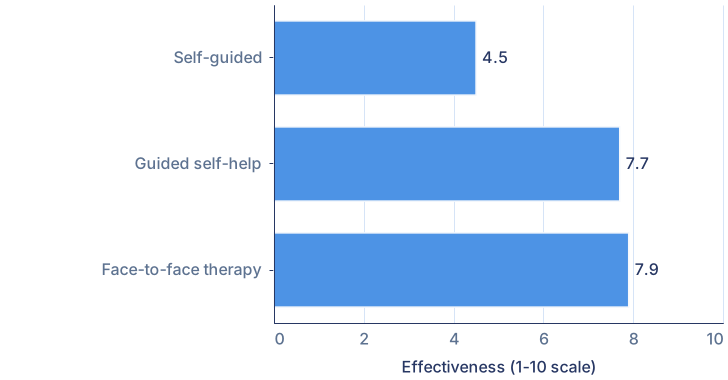
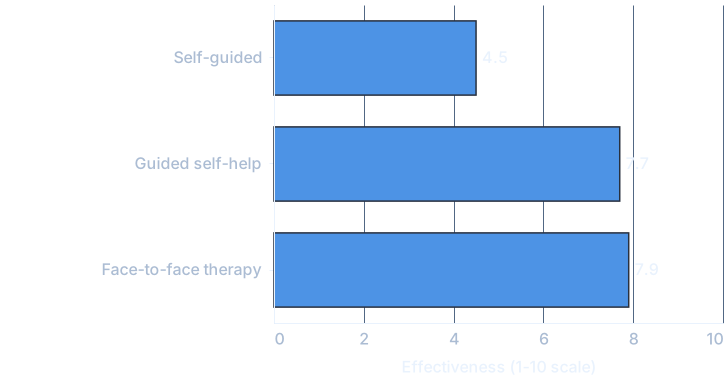
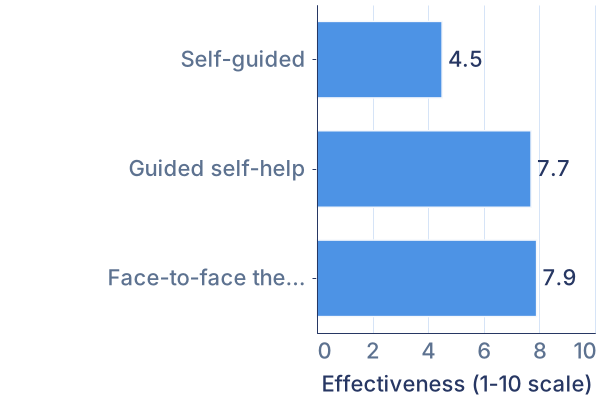
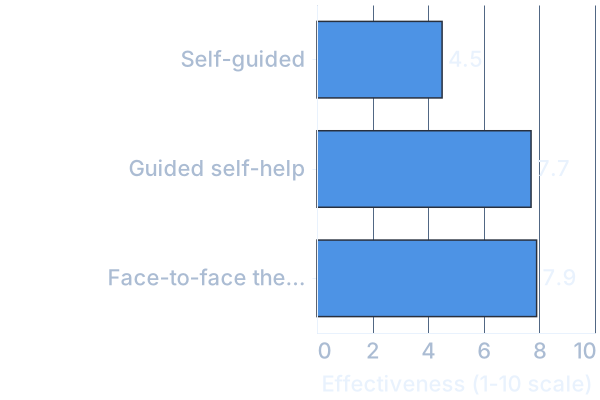
Guided self-help (structured exercises, check-ins, an app that asks follow-up questions) closes most of the gap with face-to-face therapy. You don't need a perfect setup. You just need some structure.
5 techniques you can start today
1. Spot your thinking patterns
Your brain distorts reality in predictable ways. All-or-nothing thinking turns one bad day into proof that everything is falling apart. Catastrophizing takes a small worry and builds it into a worst-case scenario. Mind reading convinces you that everyone in the room is judging you, without any actual evidence.
Once you learn these patterns, they lose their grip. You don't have to fix them in the moment. Just noticing "oh, I'm catastrophizing again" creates a pause between the thought and your reaction to it. That pause is where change starts.
2. Challenge your thoughts on paper
Write down what happened, what you thought about it, and how it made you feel. Then ask: is this thought the whole truth? What would I say to a friend thinking this?
This is the thought record, and it's the most widely used tool in CBT. The act of writing shifts your relationship to the thought. You go from being inside it to looking at it from the outside. That distance changes everything. We have a full guide on how to reframe negative thoughts if you want the step-by-step.
3. Do one thing (behavioral activation)
When depression kills motivation, waiting until you "feel like it" doesn't work. The motivation doesn't come first. Action does.
This is called behavioral activation, and research shows[3] it works as well as medication for severe depression. The approach is counterintuitive: instead of waiting for motivation to show up, you schedule a small activity and do it regardless of how you feel. Not "go to the gym." Just "put on your shoes." Or "text one friend." Or "walk around the block."
The doing changes the feeling. Not the other way around. Start absurdly small. The rest follows more often than you'd expect.
4. Face what you're avoiding
Avoidance keeps anxiety alive. Every time you dodge the thing you're afraid of, your brain files it as dangerous. The anxiety doesn't go away. It gets reinforced.
Gradual exposure means approaching feared situations in small, manageable steps. Start with the least scary version. A phone call before a meeting. One social event before a full calendar. Raising your hand once before volunteering to present.
The discomfort is temporary. Each time you face the fear and survive it (which you will), the anxiety shrinks slightly. Over time, the thing that once felt impossible becomes ordinary.
5. Solve one problem
When everything feels overwhelming, your brain treats every problem as equally urgent and equally unsolvable. Structured problem-solving cuts through that.
Pick one problem. Just one. Define it specifically ("I'm behind on rent" is more useful than "everything is terrible"). Brainstorm solutions without judging them. Pick the most realistic one. Try it. Review what happened.
This converts "I'm trapped and there's nothing I can do" into "here is one thing I can do about one specific thing." That shift, from "I can't do anything" to "I can do this one thing," is often enough to break the paralysis.
Books that have been tested in real studies
Two books stand out because they've actually been tested, not just sold on bestseller lists.
David Burns' Feeling Good teaches you to identify cognitive distortions and challenge them with practical exercises. Research on CBT homework[4] found that people who actually completed self-help exercises between therapy sessions saw significantly larger improvements in depression, suggesting the exercises themselves carry real weight.
Greenberger and Padesky's Mind Over Mood walks you through thought records with real examples. It's the go-to workbook that therapists assign as homework. Both have evidence behind them, and they cost less than a single therapy session.
Quick reference
| Technique | Best for | Time | Deeper guide |
|---|---|---|---|
| Spot patterns | Building awareness | 2 min | Cognitive distortions |
| Thought record | Challenging thoughts | 10-15 min | The thought record |
| Do one thing | Low motivation | 1 min | |
| Face avoidance | Anxiety | Varies | |
| Solve one problem | Overwhelm | 10 min |
Where AI fits
The biggest factor in whether self-help CBT works isn't the technique. It's whether you stick with it. Completion rates tell the story:
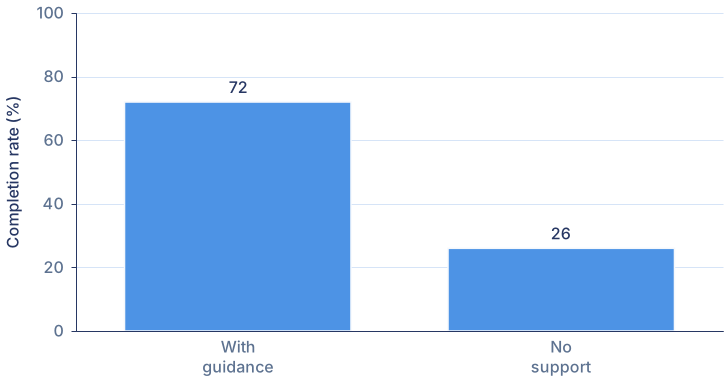
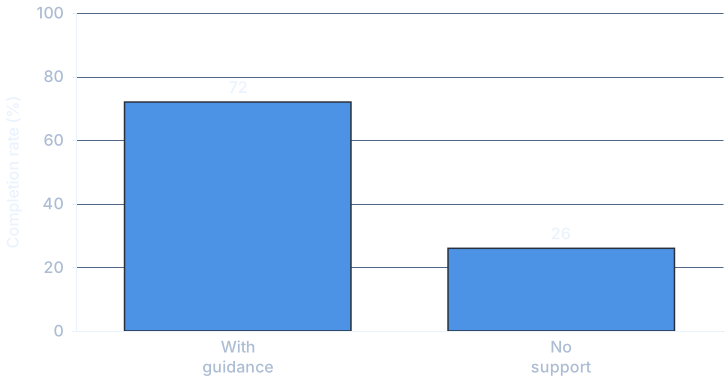
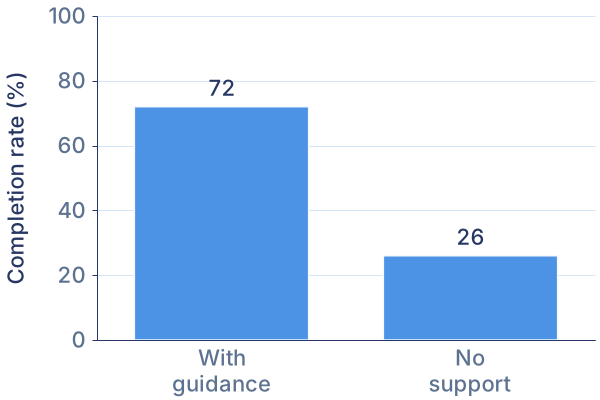
The drop from 72% to 26% without any guidance is dramatic. AI-guided tools sit in between pure self-help and therapist-guided care. They can ask follow-up questions when you get stuck, track patterns across weeks and months, adapt to what you're actually dealing with, and provide structure when motivation dips.
The evidence for AI mental health tools is still early, but promising. A large review[5] found that mental health apps meaningfully reduced depression, anxiety, and stress. We published our own outcome data, including the limitations.
How Onsen helps
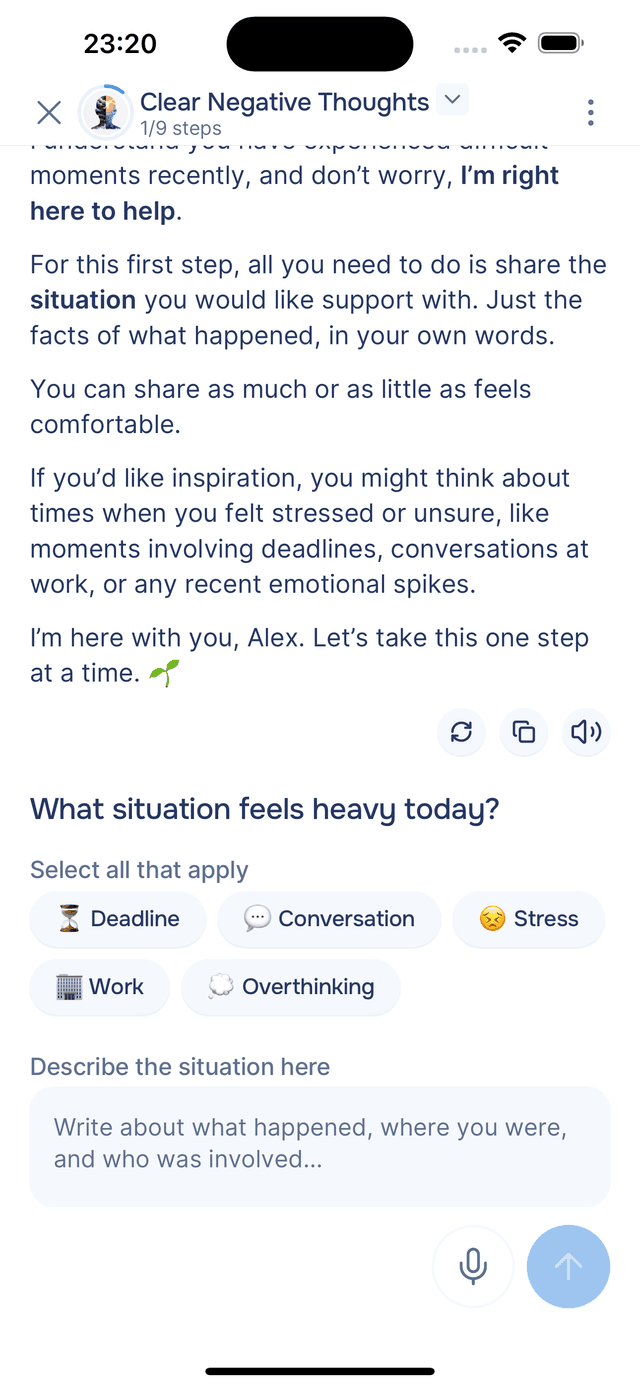
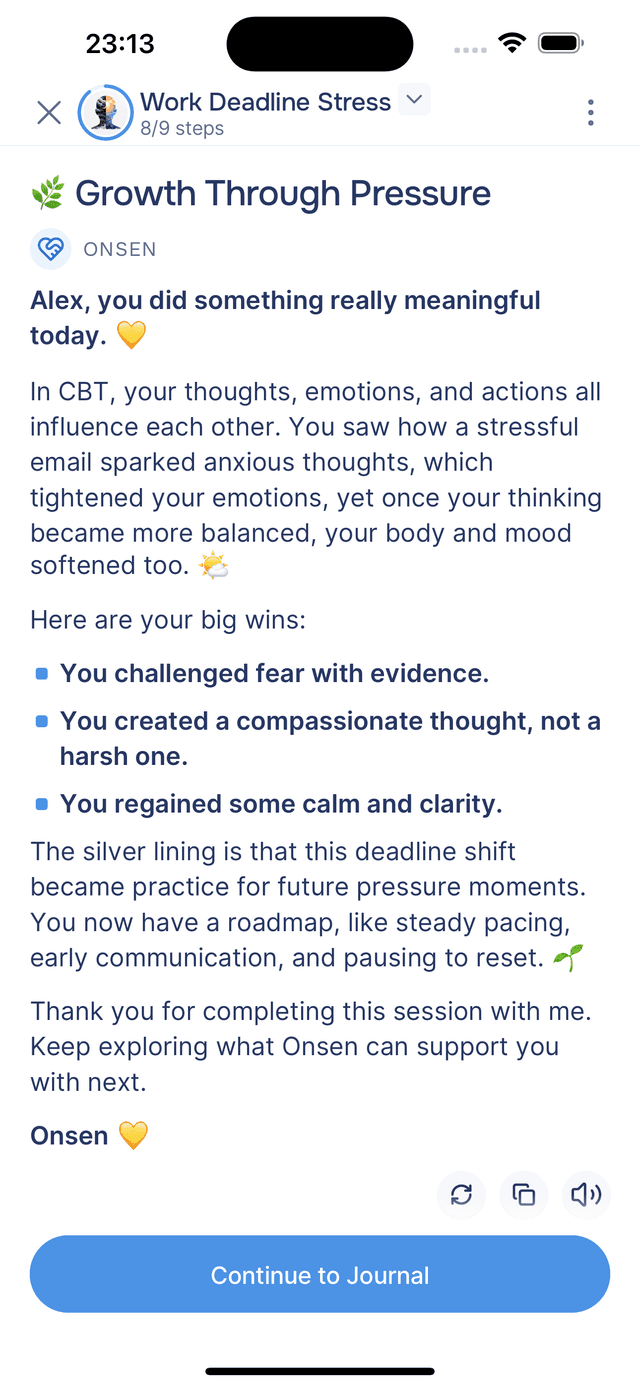
Onsen brings several of these techniques together. Clear Negative Thoughts is a guided thought record that walks you through situation, thought, evidence, and a balanced perspective. Guided Journaling gives you prompts and follow-up questions so you're never staring at a blank page. And Mood Check-In helps you track how you're feeling over days and weeks so you can spot patterns.
It's not a therapist. It's a companion for the days in between sessions, or for when sessions aren't an option yet. Download Onsen for free and start with one exercise today.
When self-help isn't enough
If therapy is out of reach financially, we wrote about real alternatives including crisis resources, community support, and sliding-scale options. And if you're wondering whether AI can replace therapy, we wrote honestly about what it can and can't do.
There's no shame in needing more help. The line between "I can work on this myself" and "I need professional support" is important, and crossing it is a sign of strength, not weakness.
Start somewhere
Therapy is valuable. If you can access it, do. But if you can't right now, you have options.
Every technique in this article has evidence behind it. CBT works, whether it's delivered by a therapist, a workbook, or an app. The format matters less than the doing.
Pick one technique. Try it this week. Doing something is always better than doing nothing. And if you want to go deeper on any of these approaches, we have detailed guides on perfectionism, catastrophizing, negative self-talk, and journaling.
Sources
- 1.
- 2.
- 3.
- 4.
- 5.