Common cognitive distortions and how to spot them
Your brain lies to you. Learn to catch it.

Your brain lies to you in predictable ways. Not out of malice. It's trying to protect you. But the mental shortcuts it takes can make everything feel worse than it actually is.
In the 1960s, a psychiatrist named Aaron Beck noticed something about his depressed patients. They weren't just sad. They were thinking in consistent, distorted patterns. He identified specific types of thinking errors that show up across anxiety, depression, and everyday stress. His student David Burns later expanded and popularized these patterns[1], calling them cognitive distortions.
The good news: once you learn the patterns, they lose much of their power. Cognitive behavioral therapy (CBT) is built on this idea, and it remains one of the most effective treatments[2] for anxiety and depression precisely because recognizing distorted thinking is a skill anyone can develop.
What one bad morning actually looks like
Let's walk through an ordinary Tuesday to see how these distortions work together.
You wake up 20 minutes late. Your first thought: "The whole day is ruined." (All-or-nothing thinking.) You rush through getting ready, check your phone, and notice your friend hasn't replied to a text from yesterday. "She's definitely mad at me." (Mind reading.) You get to work and realize you forgot to send an email your manager asked for. "This proves I'm incompetent. I'm going to get fired." (Personalization. Catastrophizing.)
Four distortions in under an hour, and the day has barely started. None of these thoughts are true. But each one felt true in the moment. That's what makes cognitive distortions so powerful: they don't announce themselves as errors. They feel like reality.


The 6 most common distortions
1. All-or-nothing thinking
You miss one workout and think, "I've completely fallen off." You get 89% on an exam and focus on the 11% you got wrong. Everything is either perfect or a total failure. There's no middle ground.
This distortion turns life into a pass/fail test with no partial credit. One bad day erases three good weeks. One awkward conversation means the whole relationship is doomed. In reality, most of life happens in the gray area between "perfect" and "disaster." Learning to see that gray area is one of the most useful things CBT teaches. When you catch yourself thinking in extremes, try asking: "Is there a middle ground I'm not seeing?"
2. Catastrophizing
A small chest pain, and suddenly you're planning your funeral. Your boss wants to "chat later," and you've already mentally packed your desk. Your brain jumps to the worst possible outcome and skips everything in between.
Catastrophizing has two parts: overestimating how likely the bad outcome is, and underestimating your ability to cope if it happened. Research shows[3] that people who catastrophize rate terrible outcomes as far more probable than they actually are. The worst case is almost never the most likely case. We wrote a full guide on how to stop catastrophizing if this one hits close to home.
3. Mind reading
Your boss is quiet in a meeting, and you assume she hates your presentation. Your partner sighs, and you decide they're frustrated with you. You're writing a detailed story about someone else's inner world with zero evidence.
The tricky part is that mind reading sometimes feels justified. You might be right occasionally. But you're working from your own fears, not from anything the other person actually said or did. A better approach: ask. "You seemed quiet in the meeting. Everything okay?" The real answer is almost always less dramatic than the one your brain invented.
4. Emotional reasoning
You feel like a fraud at work, so you conclude you ARE a fraud. You feel anxious about flying, so flying must be dangerous. You feel unlovable, so you must be unlovable.
This distortion treats emotions as evidence. And emotions can be incredibly convincing. But feelings aren't facts, even when they feel like facts. Anxiety doesn't mean danger. Guilt doesn't mean you've done something wrong. Sadness doesn't mean your situation is hopeless. Noticing the gap between "I feel this" and "this is true" is one of the most important skills in reframing negative thoughts.
5. Should statements
"I should be further along by now." "I should be able to handle this." "I shouldn't need help."
Shoulds create guilt about the present and anxiety about the future. They're rules you didn't consciously agree to, absorbed from culture, family, social media, or comparison with other people's highlight reels. Every "should" carries an implicit "and because I'm not, something is wrong with me." Try replacing "should" with "I'd like to" or "it would be nice if." The pressure drops immediately.
6. Personalization
Your team's project fails and you assume it's entirely your fault. Your friend cancels plans and you think it must be something you did. You're taking responsibility for things that involve dozens of factors outside your control.
Personalization is exhausting because it puts you at the center of every negative outcome. The reality is that most situations involve multiple causes, multiple people, and circumstances that have nothing to do with you. Your friend canceled because they were tired. The project had issues that started before you joined. Not everything is about you, and recognizing that is actually a relief.
Other distortions you might recognize
| Distortion | What it sounds like | Why it hooks you |
|---|---|---|
| Overgeneralization | "This always happens to me" | Turns one bad event into a permanent pattern |
| Mental filter | Dwelling on the one negative comment in 20 positive ones | Filters out everything that doesn't match the bad feeling |
| Disqualifying the positive | "That compliment doesn't count, they were just being nice" | Dismisses evidence that things are actually okay |
| Labeling | "I'm a failure" instead of "I made a mistake" | Turns a behavior into an identity |
| Fortune telling | "I know this is going to go badly" | Predicts the future with zero evidence |
| Magnification | "I made one typo, the whole report is ruined" | Blows small things out of proportion |
| Minimization | "It went well, but anyone could have done that" | Shrinks your accomplishments until they disappear |
| Blaming | "This is all their fault" or "This is all my fault" | Assigns 100% responsibility to one person when reality is more complex |
These overlap with the six above. Labeling is all-or-nothing thinking applied to your identity. Mental filtering is the engine that powers emotional reasoning. Fortune telling is catastrophizing's quieter cousin. You don't need to categorize every distortion perfectly. The point is to notice when your thinking is skewed.
Now what?
Recognizing these patterns is the first step. The next is learning what to do when you catch one. We have several guides that go deeper:
- How to reframe negative thoughts walks you through the four-step process for challenging any distorted thought.
- How to stop catastrophizing covers five specific techniques for breaking the worst-case spiral.
- The thought record explains why writing your thoughts down actually changes them.
How Onsen helps
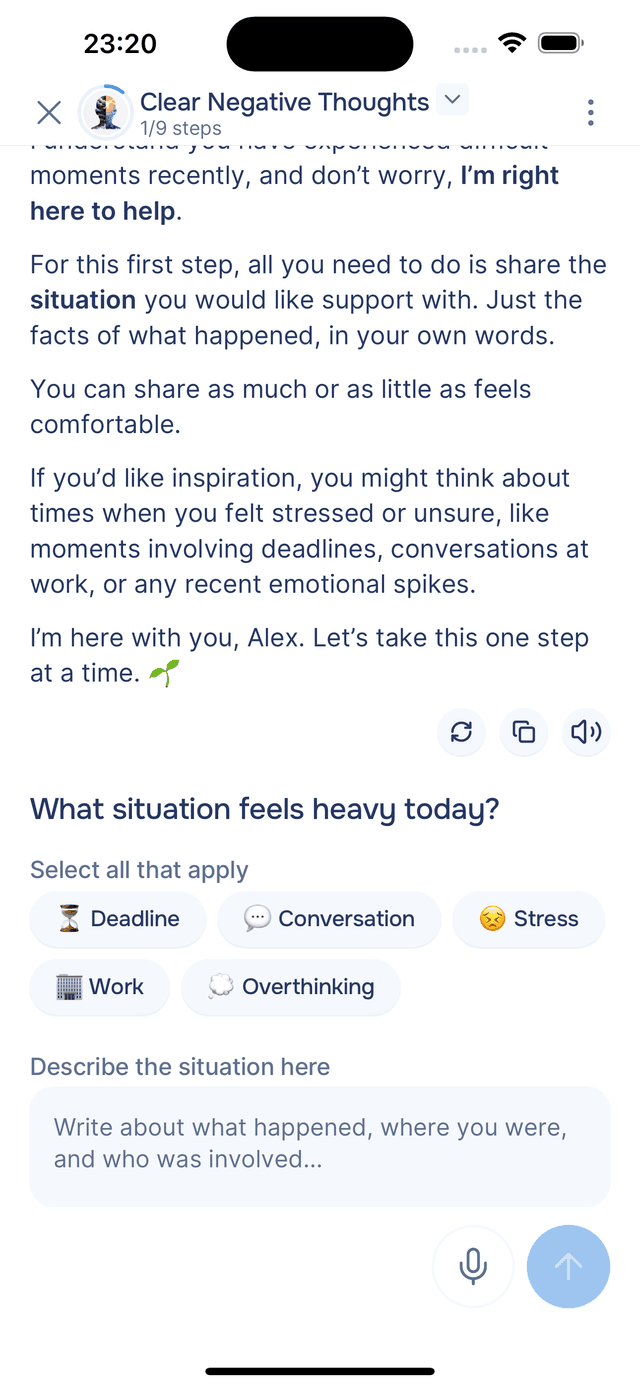
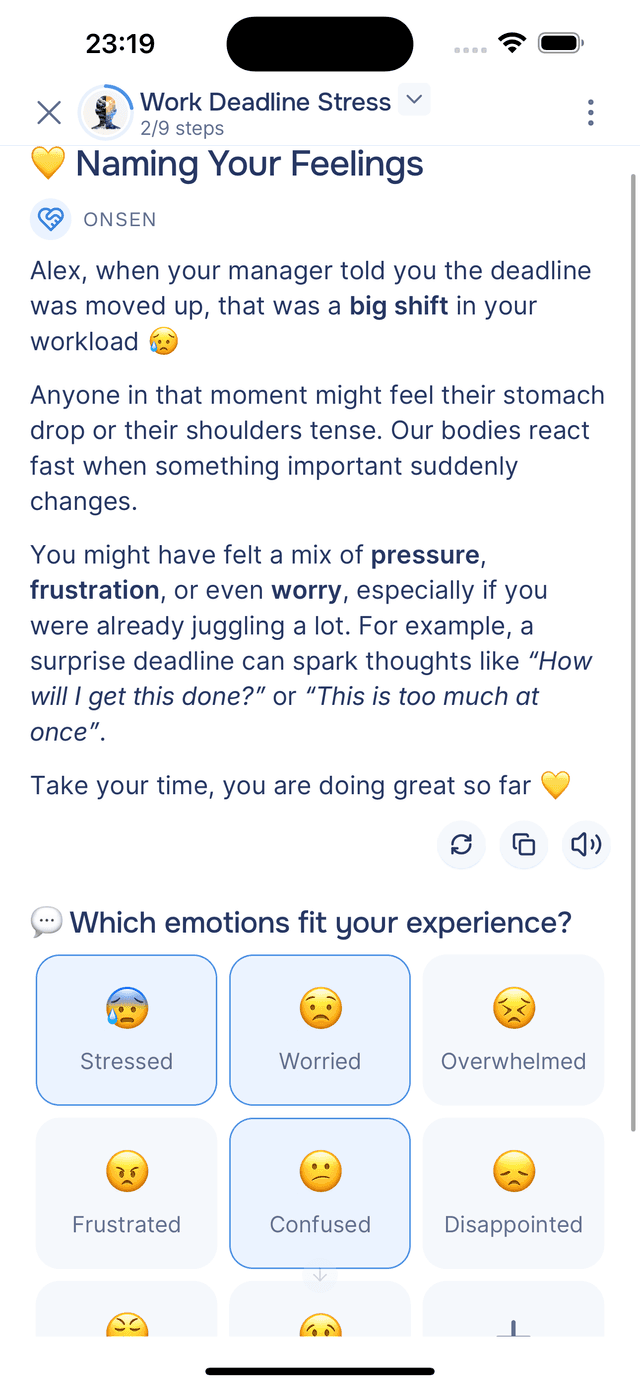
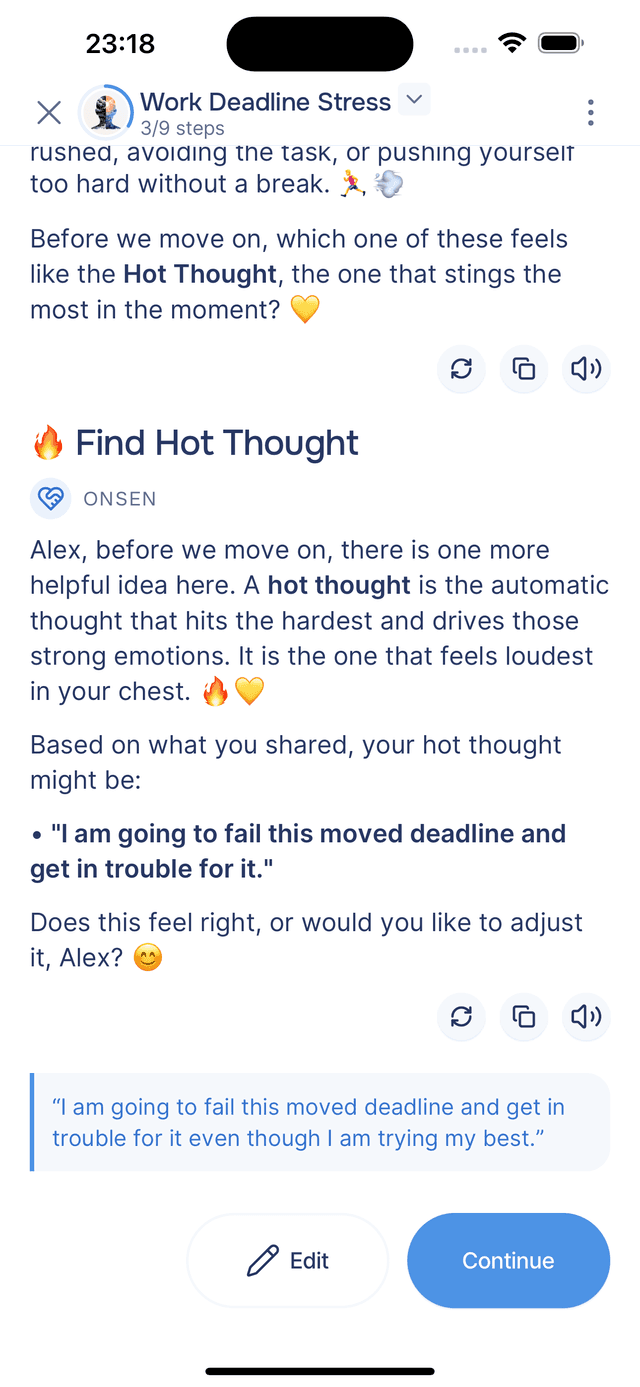
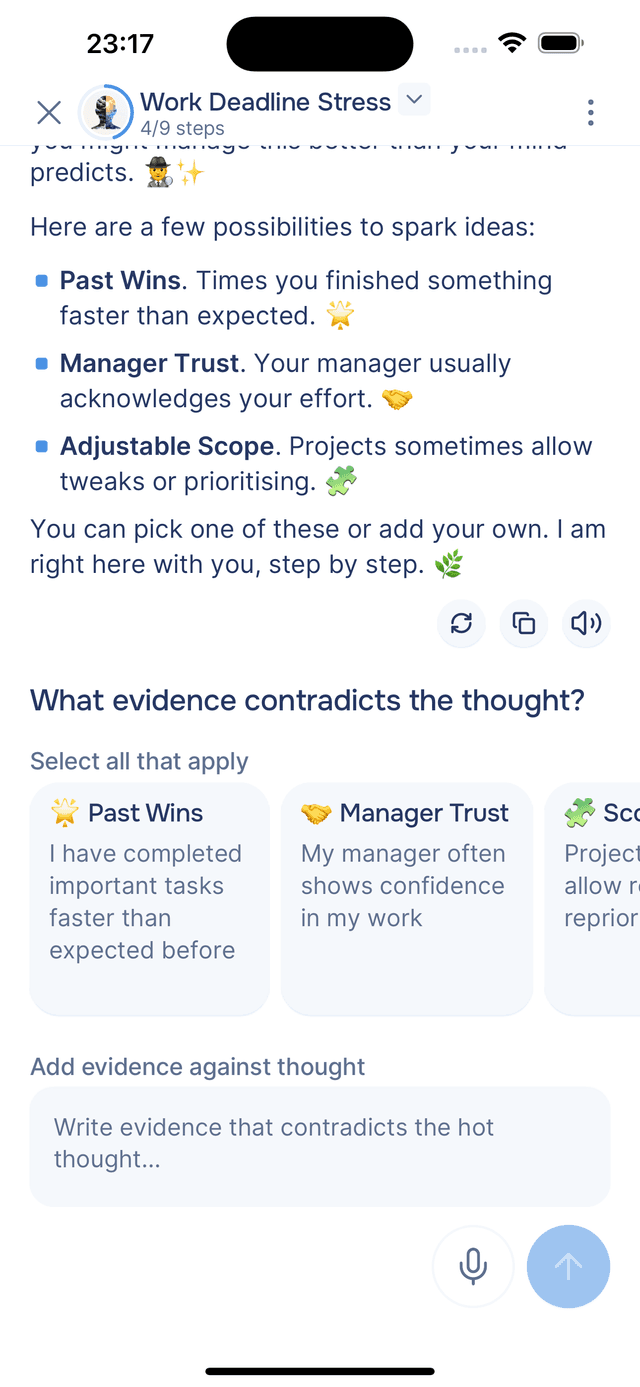
Onsen's Clear Negative Thoughts exercise walks you through identifying what happened, naming the thought, examining the evidence, and finding a more balanced perspective. It's like having a guided thought record that asks the follow-up questions for you. And because the AI actually learns your patterns over time, it gets better at spotting which distortions tend to show up most for you.
Download Onsen and try the Clear Negative Thoughts exercise. It takes about 15 minutes and you don't need any experience with CBT.
You don't have to fix all of these at once
Just start noticing. "Oh, I'm catastrophizing again." "Wait, am I mind reading right now?"
That moment of recognition, the tiny pause between the thought and your reaction to it, is where everything changes. You don't need to be perfect at this. You just need to start paying attention.
Sources
- 1.
- 2.
- 3.