How to stop catastrophizing
Your worst-case scenario is almost never the most likely one.

Your boss sends a Slack message: "Can we chat later?" And just like that, your brain has you fired, broke, and living in a van by the river. By the time you actually walk into their office (it's about a schedule change), your heart is pounding and your palms are sweating.
That's catastrophizing. Your brain took a neutral event, skipped every reasonable interpretation, and landed on the worst one.
If you do this regularly, you already know it's exhausting. The good news: it's one of the most well-studied cognitive distortions, and the techniques for breaking it actually work.
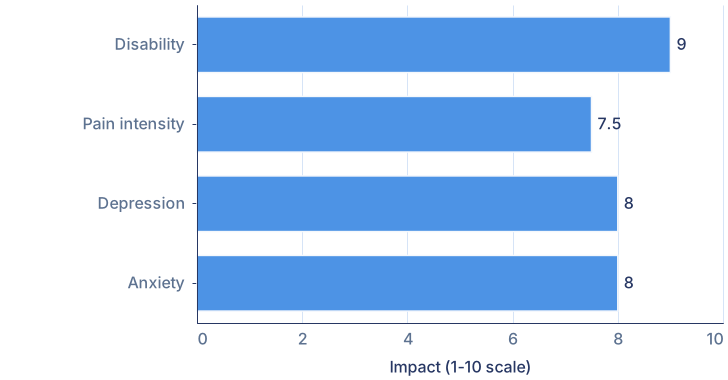
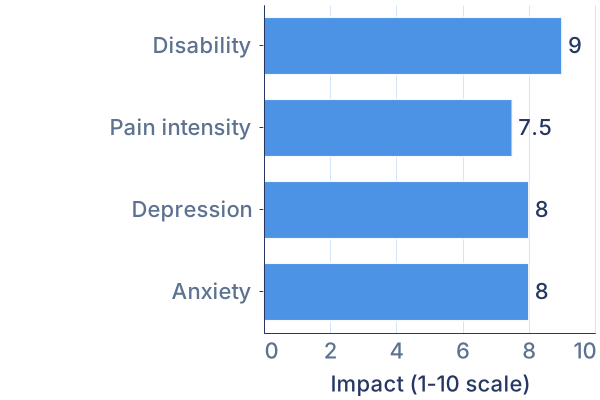
Catastrophizing doesn't just feel bad. It makes real problems worse. Across thousands of people studied, catastrophizing was strongly linked to higher pain, greater disability, and worse outcomes for anxiety and depression.[1]
What's actually happening
Catastrophizing has two parts working together.
First, your brain imagines the worst possible outcome. Not a bad outcome. The worst. A small chest pain becomes a heart attack. A friend's delayed text becomes the end of the friendship. Your brain skips the twenty reasonable explanations and jumps straight to disaster.
Second, it convinces you that you couldn't handle it if it happened. The fear isn't only "something bad might happen." It's "something bad might happen AND I'll fall apart."
Both parts need to be addressed. Telling yourself "that probably won't happen" doesn't help much if you still believe you'd crumble if it did.
The spiral feeds itself
When you catastrophize, your body responds as if the worst case is already happening. Your heart rate goes up. Your muscles tense. You might feel dizzy, short of breath, or nauseous. And that physical response makes the thought feel MORE real. If your body is reacting this way, it must be serious, right?


Research confirms[1] that people who catastrophize rate terrible outcomes as far more likely than they actually are, and that each round of "what if" makes the distress worse. The worry doesn't resolve. It escalates. This is why telling yourself to "just stop worrying" doesn't work. The loop is self-reinforcing.
5 ways to break the spiral
1. Ask three questions
This is the simplest and most immediately usable technique. When you catch yourself catastrophizing, ask:
What's the worst that could happen? (You're already doing this one. Write it down.)
What's the best that could happen? (Force yourself to imagine it. It's harder than it sounds.)
What's most likely to happen? (This is where reality lives. The most likely outcome is almost always boring.)
Walk through a real example. Your boss wants to talk. Worst case: you're being let go. Best case: you're getting a raise. Most likely: they need to discuss a scheduling change, or a project update, or something you'll forget about by tomorrow. The most likely answer is usually undramatic. That's the whole point.
2. Check the probability
Your brain treats unlikely events as inevitable. Put a number on it. "What are the actual chances this will happen?" Not "is it possible?" (almost anything is possible) but "is it probable?"
Most catastrophic predictions fall below 5% probability when you actually think about it. The flight will probably land safely. The doctor's appointment will probably be routine. The presentation will probably go fine. "Probably" isn't as satisfying as "definitely," but it's almost always more accurate.
3. Check your coping ability
"If the worst DID happen, what would I actually do?"
You've survived 100% of your worst days so far. You've handled things you never thought you could handle. You've found solutions to problems that seemed unsolvable at 2am. Catastrophizing tells you that you'd fall apart. Your actual track record says otherwise.
Building confidence in your ability to cope[2] directly weakens catastrophizing. The second half of the catastrophe ("and I won't be able to handle it") is usually the more damaging part.
4. Postpone the worry
This sounds too simple to work, but it does. Set a specific 15 to 30 minute "worry window" somewhere in your day (not right before bed). When catastrophic thoughts arise outside that window, acknowledge them and postpone: "I'll think about this at 5pm."
A review of the research[3] found that this approach reduces both how often people worry and how long each episode lasts. Most people find that by the time the worry window arrives, the urgency has passed. The catastrophe that felt enormous at 10am feels manageable by 5pm. And if it doesn't, you've still given yourself a contained space to think it through rather than letting it consume the whole day.
5. Write it down
Putting catastrophic thoughts on paper changes them. When the thought is in your head, it feels enormous, urgent, true. On paper, it's just a sentence. You can look at it from the outside instead of being trapped inside it.
Research on expressive writing[4] shows that writing about anxious thoughts makes them feel smaller, and the relief sticks around. Journaling turns the invisible spiral into something you can see, question, and respond to. If you're mid-catastrophe and can barely think straight, even scribbling "I'm afraid that ___" gives you something to work with.
Quick reference
| Technique | What to do | Speed |
|---|---|---|
| Three questions | Ask: worst, best, most likely? | Instant |
| Probability check | Put a % on it | 30 seconds |
| Coping check | "What would I actually do?" | 1 minute |
| Worry postponement | Delay to a set worry window | Ongoing |
| Write it down | Journal the fear | 5 minutes |
How Onsen helps
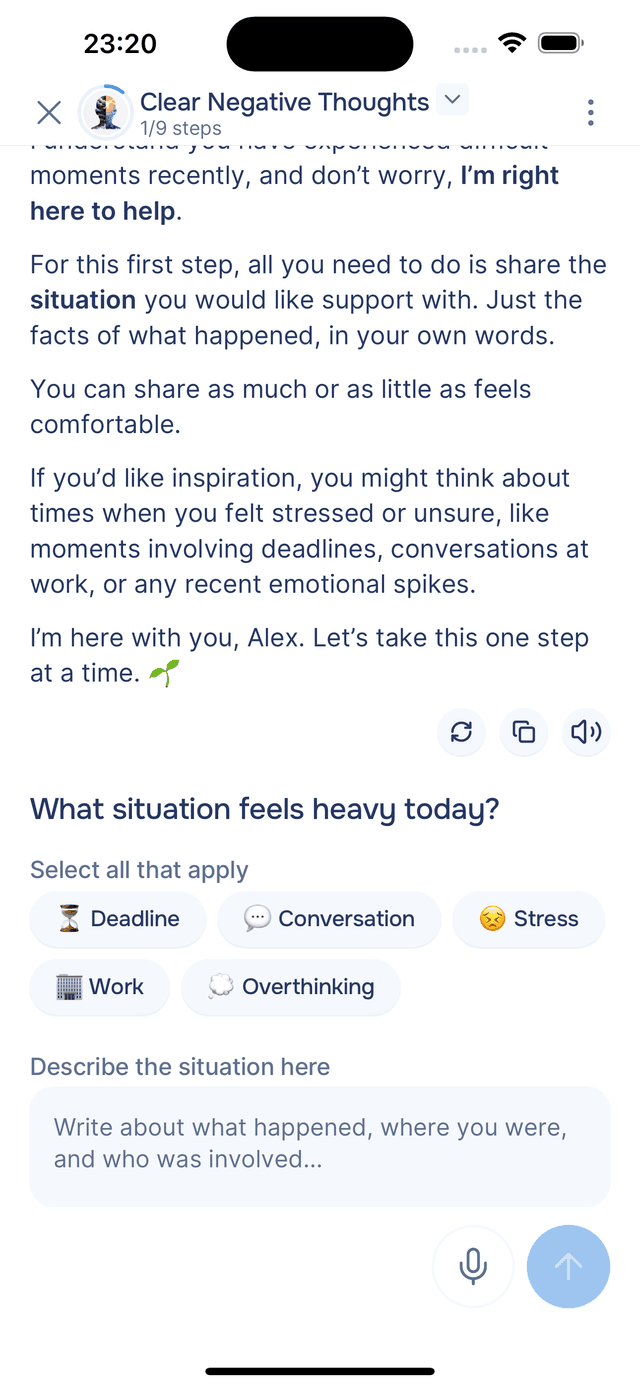
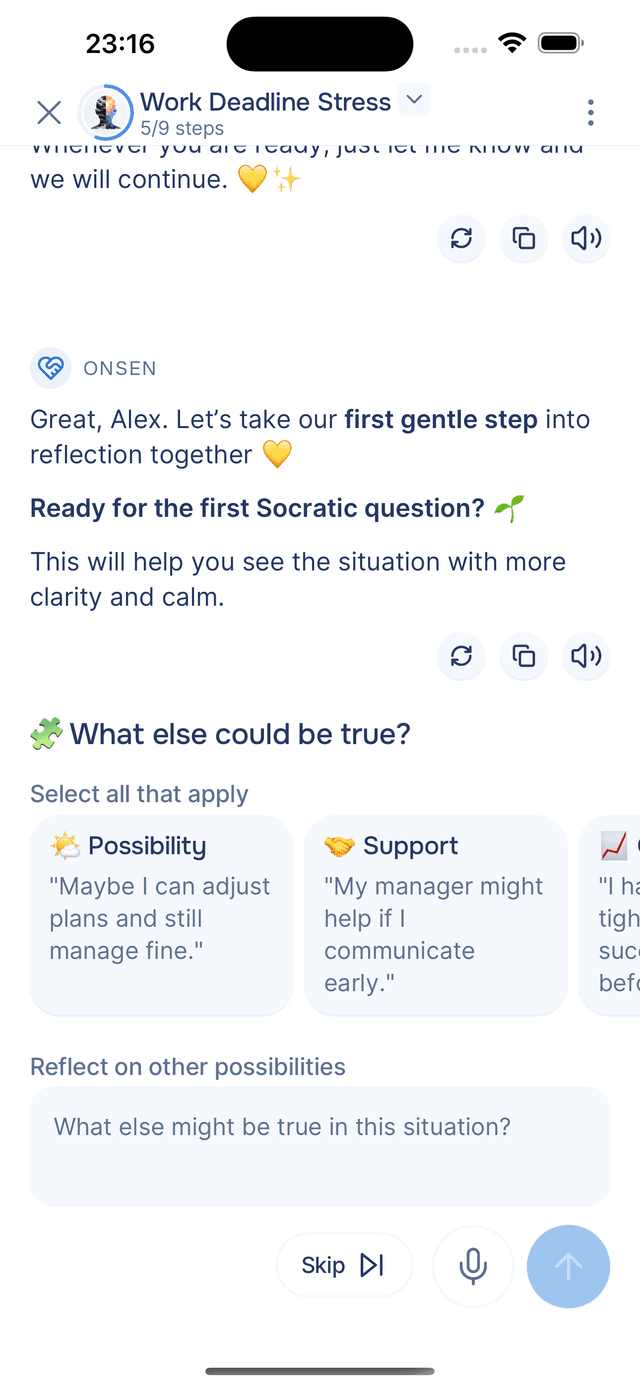
Onsen's Clear Negative Thoughts exercise guides you through this process step by step. You name what happened, identify the catastrophic thought, examine the evidence for and against it, and find a more balanced perspective. When you're in the middle of a spiral and can't think clearly, having the structure handed to you makes a real difference.
And when the catastrophizing hits at 2am and you just need to talk it out, Just Chat is there. Sometimes the best way to break a spiral is to say the fear out loud (or type it) and hear how it sounds outside your head.
Download Onsen and try it next time the spiral starts. It's free and available 24/7.
The gap where your life happens
The next time your brain tries to convince you the sky is falling, pause. Ask: what's actually most likely here?
The answer is almost always less dramatic than the movie your brain is playing. And that gap between the catastrophe you imagined and the reality you're living in? That's where most of your life actually happens. The more you practice noticing the gap, the smaller the catastrophes get.
You won't stop your brain from jumping to worst cases entirely. That's just what brains do. But you can get better at catching it, pausing, and choosing a different response. And over time, the pause gets longer and the spiral gets shorter.
If catastrophizing is one of many thinking patterns you've noticed, or if you want to understand why writing things down changes thinking at a deeper level, those are good next steps.
Sources
- 1.
- 2.
- 3.
- 4.