How to challenge negative self-talk
You'd never talk to a friend the way you talk to yourself.

There's a voice in your head that says things like "you're not good enough," "everyone can tell you're faking it," and "you're going to fail." You'd never say these things to someone you love. But you say them to yourself a dozen times a day.
That voice isn't random. And it isn't you, exactly. It's a pattern, and patterns can change.
Where the inner critic comes from
Self-talk develops from the voices we heard growing up. A critical parent's disappointment. A teacher who pointed out what you did wrong more often than what you did right. A group of kids who found the thing you were most insecure about and made sure you never forgot it.
Over time, those external voices become internal ones. You internalize someone else's criticism and start treating it as your own. The teacher who said "you should try harder" becomes the voice that whispers "you're lazy" every time you rest. The parent who expected perfection becomes the voice that says "that's not good enough" about everything you do.
Understanding this doesn't silence the critic. But it helps you see it for what it is: an echo from your past, not the truth about your present.
What it costs you
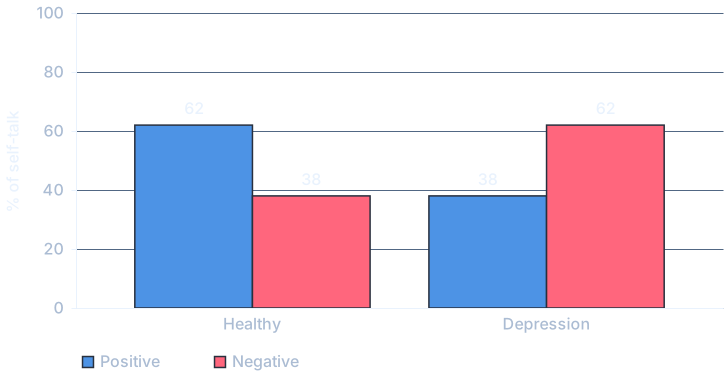
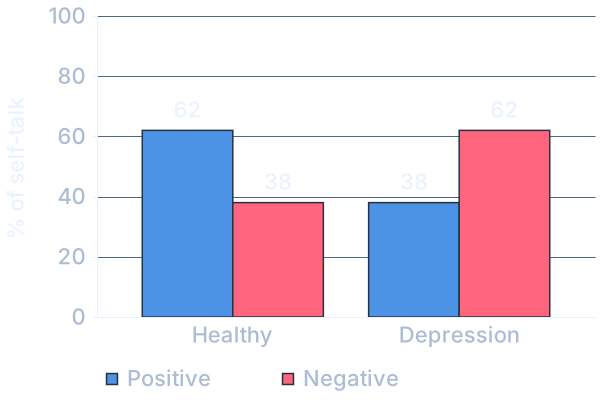
In people who are doing okay mentally[1], positive self-talk outweighs negative by roughly 60/40. In depression, that ratio flips.
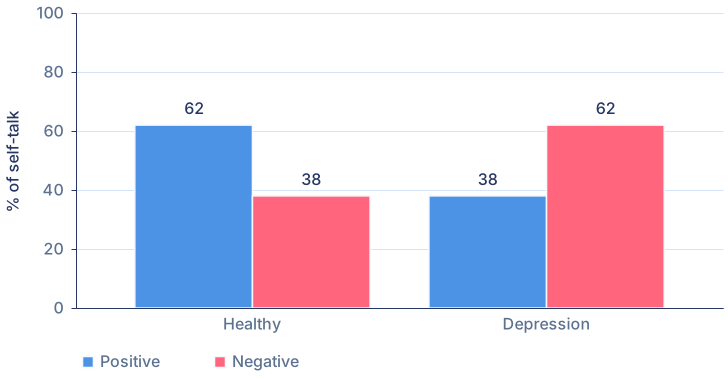
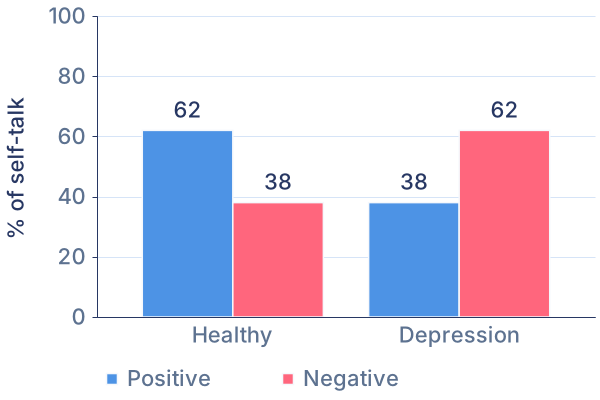
The impact goes beyond feeling bad. It changes your behavior. When "I'll probably fail" becomes your default thought, you stop reaching for things. You turn down the opportunity, cancel the plan, stay quiet in the meeting. The inner critic creates the very outcomes it predicts. Tell yourself you'll fail often enough and you'll stop trying, which looks a lot like failing.
Research[2] found that how often you beat yourself up is one of the strongest signs of depression. It's both a symptom and a driver of the cycle.
4 ways to change the conversation
1. The friend test
"What would I say to someone I love in this situation?"
If your friend said "I messed up the presentation and now everyone thinks I'm incompetent," you wouldn't respond with "yeah, you probably are." You'd offer context. You'd remind them of the presentations that went well. You'd say something kind and true.
That response is available to you too. The gap between how you treat yourself and how you treat the people you love is the gap the inner critic lives in. Closing it doesn't require a complicated technique. It requires asking one question and giving yourself the same answer you'd give a friend.
2. Third-person self-talk
Research found[3] that referring to yourself by name takes some of the emotional charge out of the moment. "Sarah, you can handle this" works better than "I can handle this." It sounds odd, but the reason is simple: using your name creates a bit of distance, the same kind of distance you automatically have when thinking about someone else's problem.
It takes almost no effort. You can do it silently, in real time, without anyone knowing. And the studies show it works even for people under significant stress. Try it the next time you catch your inner critic mid-sentence. Replace "I" with your name and notice what shifts.
3. Name the voice
Give your inner critic a character. "There goes the Perfectionist again." "The Catastrophizer is back." "Hello, Imposter Syndrome, I see you."
This does something subtle but powerful. It separates you from the thought. Instead of being consumed by "I'm a fraud," you're observing a familiar pattern: "The voice that tells me I'm a fraud is active today." You shift from being the thought to watching the thought. That shift is the foundation of cognitive behavioral therapy, and naming the voice is one of the easiest ways to practice it.
4. Defusion
"I notice I'm having the thought that I'm not good enough."
You don't fight the thought. You don't argue with it. You don't try to replace it with something positive. You simply acknowledge it and give it space to pass.
Research[4] suggests that changing how you relate to a thought can be just as powerful as trying to change the thought itself. When you stop treating the thought as a fact and start treating it as mental weather (it arrived, it'll pass), it loses its grip. You don't have to believe every thought that shows up.
Quick reference
| Technique | What you do | When to use it |
|---|---|---|
| Friend test | Ask what you'd tell a friend | First response, anytime |
| Third-person | Use your name instead of "I" | Mid-spiral, need quick distance |
| Name the voice | Give the critic a character | Recurring patterns |
| Defusion | "I notice I'm having the thought..." | Too tired to argue with it |
This takes time
You're rewiring patterns that took years to build. Research suggests[5] that forming new mental habits takes roughly two months of consistent practice. Some days the critic will be louder than others. You'll have weeks where you feel like you've made progress and weeks where it feels like you're back to square one.
That's not failure. That's the process. The goal isn't to never have a negative thought. It's to change what happens after the thought arrives. The critic speaks, and instead of believing it, you pause. That pause gets longer with practice. And in that pause, you get to choose how to respond.
How Onsen helps
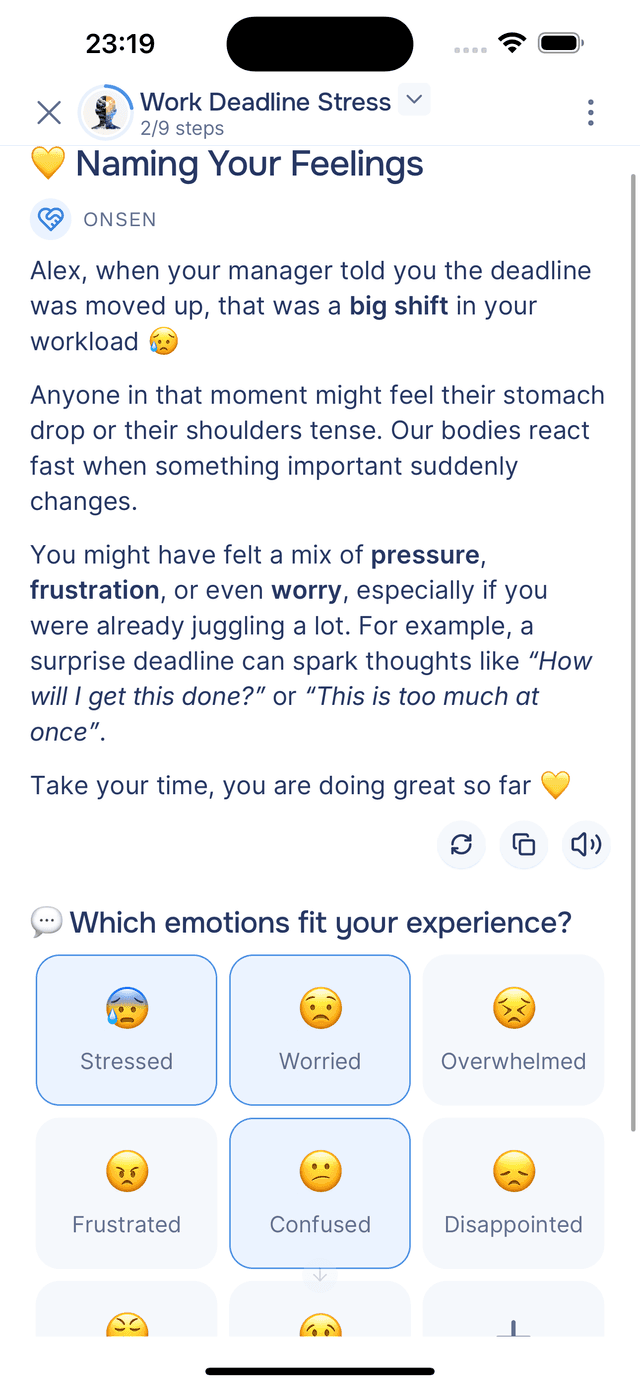
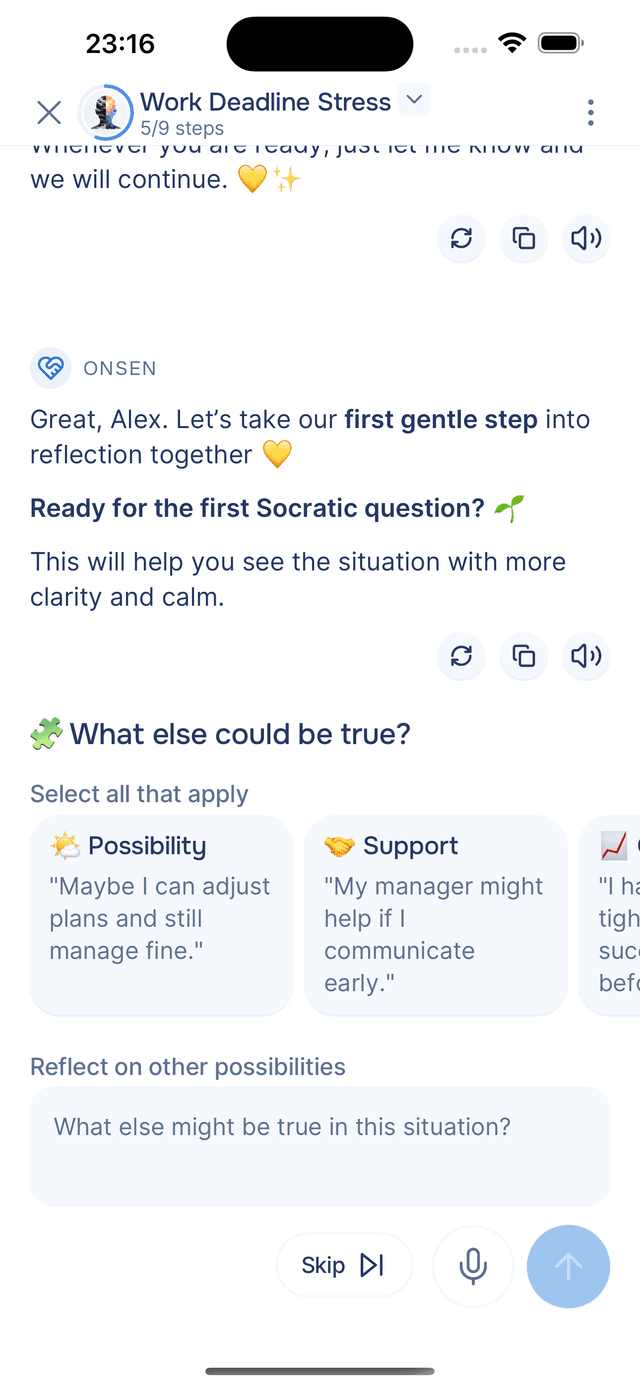
When the inner critic gets loud, Onsen gives you somewhere to go. Just Chat lets you talk through what you're feeling without judgment. Clear Negative Thoughts helps you take one specific self-critical thought and examine whether it's actually true. And Guided Journaling helps you notice patterns over time: which situations trigger the critic, what it tends to say, and whether those themes connect to something deeper.
Download Onsen and talk back to the inner critic. It's free and judgment-free.
Changing the conversation
You can't silence the inner critic. But you can stop letting it run the show.
The goal isn't a quiet mind. It's a mind where the critic speaks and you get to decide whether to listen. Where "you're not good enough" arrives, and instead of accepting it as fact, you ask: "Is that true? Or is that just a voice from a long time ago that hasn't updated its story?"
Most of the time, it's the second one.
If perfectionism drives your self-talk, or if the negative thoughts connect to something that feels like depression, those are worth exploring too. And if you want to understand the broader patterns, our guide to cognitive distortions covers the thinking traps that fuel the inner critic.
Sources
- 1.Alderson-Day, B. & Fernyhough, C. (2015). “Inner speech: development, cognitive functions, phenomenology, and neurobiology.” [PMC ]
- 2.
- 3.
- 4.
- 5.Lally, P. et al. (2010). “How are habits formed: modelling habit formation in the real world.” [onlinelibrary.wiley.com ]