CBT for perfectionism
The standards keep moving. You never quite reach them.

You set impossible standards, beat yourself up when you don't meet them, and then set even higher ones to compensate. You call it "having high standards." But the standards keep moving, and you never quite reach them.
If this sounds familiar, you're not alone. Perfectionism is rising sharply[1] among young adults, driven by social pressure, competitive culture, and the feeling that everyone else has it together (they don't).
The part that might surprise you
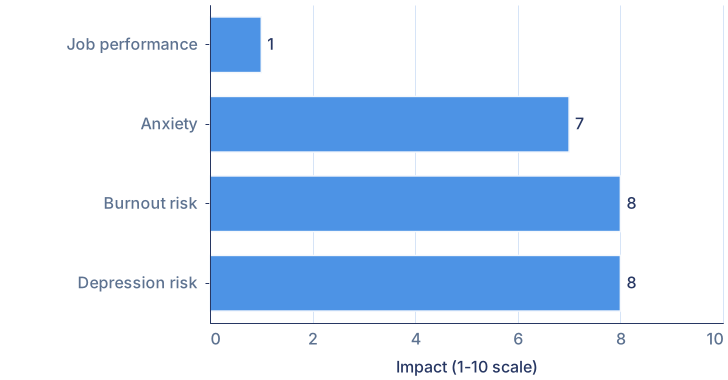
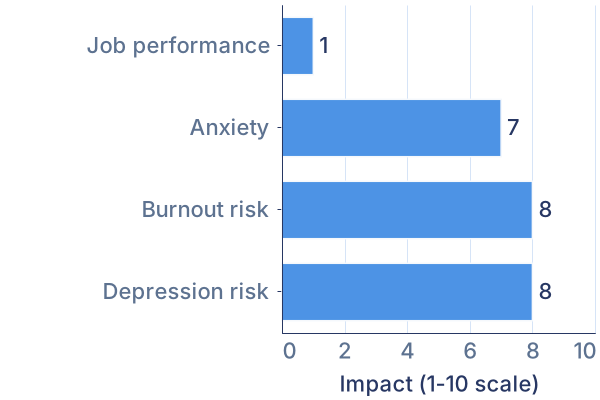
Perfectionism barely affects how well you actually do your job.[2]
Study after study found the same thing: perfectionists produce roughly the same results as everyone else. Perfectionists work harder, worry more, and produce roughly the same results as everyone else. In academics, the connection is barely there[3] too. Students with perfectionistic tendencies don't earn better grades. They just feel worse about the grades they get.
Perfectionism doesn't make you better. It just makes you more anxious about not being good enough.
Think about that for a second. All the extra hours, the triple-checking, the rewriting. The late nights spent polishing something nobody else would notice. The research says it doesn't move the needle. What it does move is your stress level, your sleep, and your mental health.
The perfectionism trap
Success doesn't satisfy you. You finish a project and immediately discount it ("anyone could have done that"). Failure confirms your worst fear ("I knew I wasn't good enough"). Both outcomes keep the cycle going. There's no way to win.
This is the core of what makes perfectionism so sticky. It's not one bad thought. It's a closed loop:


The loop feels productive. It feels like caring about quality. But the engine underneath it is fear, not ambition.
What it actually costs
Perfectionism isn't just stressful. It's linked to depression, anxiety, eating disorders, OCD, and burnout[4]. In its most severe form, it's connected to suicidal ideation[5], particularly when someone believes that other people demand perfection from them.
That last part matters. There's a difference between the standards you set for yourself and the standards you think other people demand from you. That second kind is the most harmful. It's the voice that says "if I slip up, everyone will know I'm a fraud." And it's the form that's growing fastest among young people.
The pressure to perform has never been higher. Social media shows you curated highlight reels. Workplaces reward overwork. Schools rank and sort from childhood. Perfectionism feels rational in that environment. But the costs are real.
What actually helps
CBT is the best-studied approach for perfectionism. It works because perfectionism is, at its core, a pattern of distorted thinking. You overestimate the consequences of imperfection and underestimate your ability to handle them. CBT targets those distortions directly.
1. Behavioral experiments
Do something at 80% effort and see what happens.
Send the email without triple-checking it. Submit the report a day early instead of polishing until midnight. Post the photo without adjusting the filter six times. The point isn't to do sloppy work. The point is to test whether your prediction ("people will notice, they'll think less of me") actually comes true.
This is the most powerful CBT technique for perfectionism because it generates real evidence. Not evidence from your imagination, which tends toward catastrophe, but evidence from your actual life. One study[6] found that 75% of people who tried this approach saw significant improvement.
Perfectionists are consistently shocked that nobody notices the difference between their 80% and their 100%. That shock is the medicine.
2. Surveys
Ask other people what their standards actually are.
"How much time do you spend on a work email?" "Do you proofread your texts?" "How often do you make mistakes at work?" Perfectionists avoid these conversations because they assume everyone else shares their impossibly high standards. They don't.
The gap between what you assume and what's real is enormous. You picture your colleagues agonizing over every comma while they're sending emails from the bathroom without a second glance. Research confirms[7] that perfectionists rarely test their assumptions about others' expectations, and when they do, they're almost always wrong. The surveys don't just provide information. They dissolve the illusion that everyone else operates at 100% all the time.
3. The double standard
"Would you judge a friend this harshly for the same mistake?"
Perfectionists apply rules to themselves they'd never impose on someone they love. If your friend said "I made a typo in a client email and now they probably think I'm incompetent," you'd reassure them. You'd offer perspective. You'd probably laugh gently and say it happens to everyone.
But when it happens to you, it's different. It's evidence of a fundamental flaw.
When you notice yourself being cruel to yourself, pause and rewrite the thought as advice to a close friend. The kinder version is usually more accurate. This is a form of cognitive reframing, and it works because distance changes perspective. You can see your friend's situation clearly. You deserve that same clarity.
4. Self-compassion
This isn't about lowering your standards or letting yourself off the hook.
Research shows[8] that self-compassion actually increases motivation to improve after failure. In one study, people who treated themselves with kindness after a setback studied harder, spent more time preparing, and were more willing to face their weaknesses. People who beat themselves up did the opposite: they avoided the material entirely.
Self-criticism doesn't motivate you. It paralyzes you. It makes you avoid the very things you need to engage with because the emotional cost of facing another potential failure feels too high.
Self-compassion gives you the safety to try again. Not because you've lowered the bar, but because you've removed the punishment for not clearing it on the first attempt.
How Onsen helps
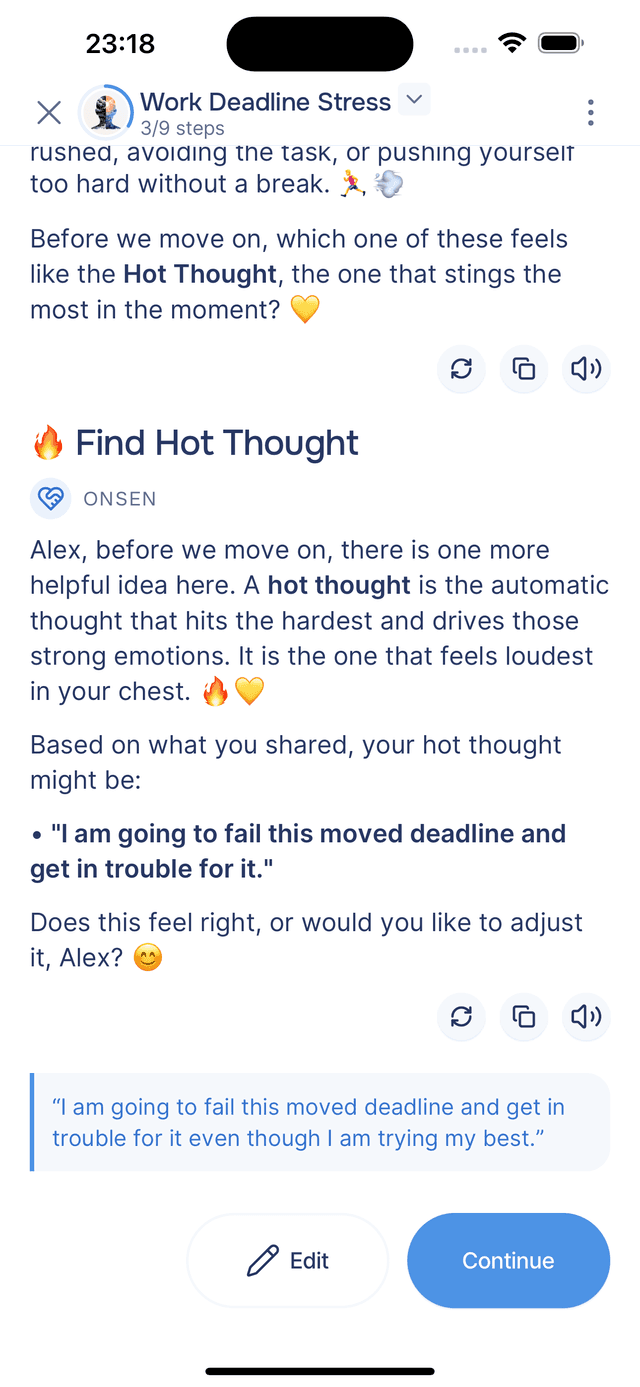
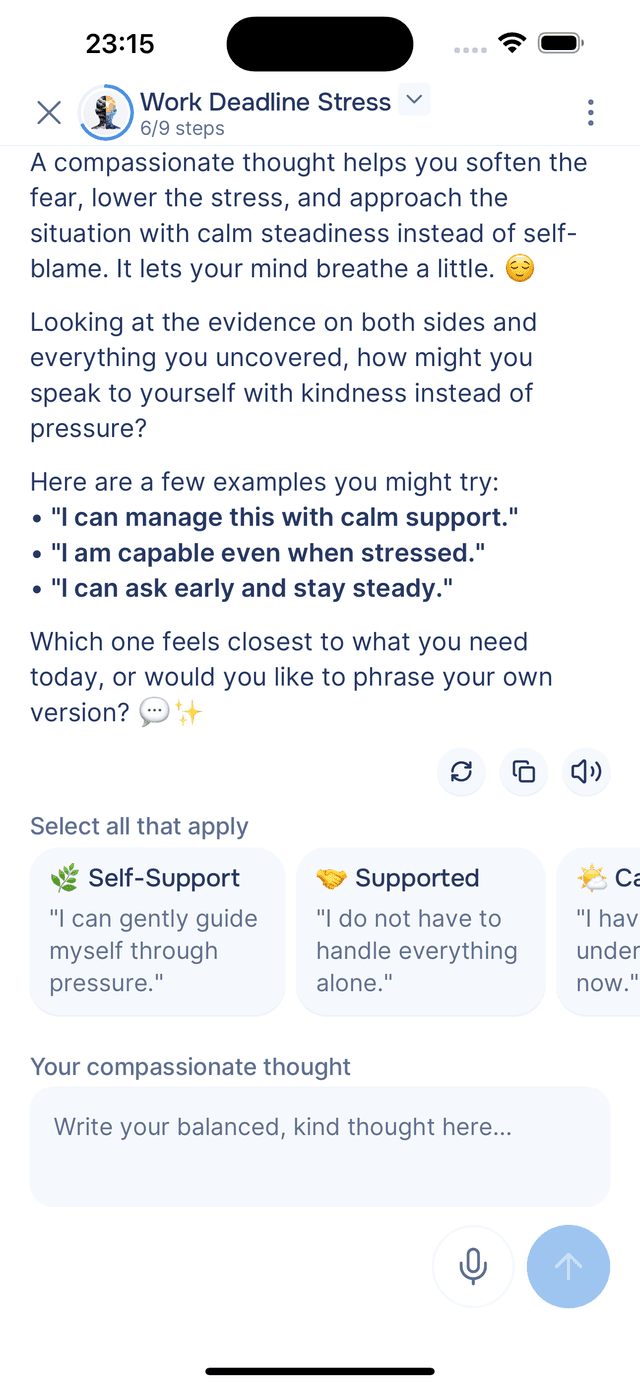
Onsen's Clear Negative Thoughts exercise is built for exactly this kind of thinking pattern. When you notice a perfectionistic thought ("if I make a mistake, everyone will think I'm incompetent"), the exercise walks you through examining the evidence and finding a more balanced perspective. Guided Journaling can also help you explore where the standards came from in the first place.
Download Onsen and try the Clear Negative Thoughts exercise next time you catch a perfectionistic thought. It's free.
The bravest thing a perfectionist can do
Perfectionism isn't excellence. It's fear dressed up as ambition. The gap between "I have high standards" and "I can't tolerate being anything less than perfect" is the gap between healthy striving and a mental health risk.
The bravest thing a perfectionist can do is be good enough on purpose. To send the email, close the laptop, and go to bed. To finish the project at 85% and discover that the world doesn't end.
You might even discover something surprising: the work is still good. It was always good. The only thing that changes is how much you suffer while doing it.
If you want to explore these ideas further:
- What is CBT and how can an app help?
- How to reframe negative thoughts (with examples)
- How to challenge negative self-talk
- How to tell if you're burned out
- Does Onsen actually work?
Sources
- 1.
- 2.
- 3.
- 4.
- 5.
- 6.
- 7.
- 8.