How to start journaling when you don't know what to write
You don't need to be a writer. You just need five minutes.

You've heard journaling is good for you. Maybe your therapist suggested it. Maybe you read one of those articles about how writing reduces anxiety. So you open a notes app, or buy a nice notebook, and then...
Nothing.
The cursor blinks. The page stares back. You have no idea what to write. You feel stupid for not being able to do something that's supposed to be simple. You close the app and don't come back.
This is the most common journaling experience in the world. And it has nothing to do with your writing ability.
The blank page is the problem, not you
Nobody tells you this about journaling: the people who do it consistently almost never start with a blank page. They start with a question, a prompt, or a specific thing that happened. The blank page is the enemy, not the solution.
Traditional journaling advice says "just write whatever comes to mind." That works for about 3% of people. For everyone else, it's like being told to "just relax" when you're anxious. Technically true, practically useless.
You need a way in. Here are five that actually work.
1. Describe what happened today
Don't try to be deep. Don't try to have insights. Just describe your day like you're telling a friend.
"Had a meeting at 10 that went longer than expected. Lunch was rushed. Got into a weird exchange with Sarah over email, not sure if she was annoyed or just busy. Felt low energy all afternoon. Made pasta for dinner."
That's it. That's a journal entry. No profundity required. What makes it useful is that over time, you start to see what keeps coming up, the patterns you don't notice in the moment.
2. Answer a single question
Instead of staring at a blank page, answer one of these:
- What's taking up the most space in my mind right now?
- What am I avoiding thinking about?
- What went well today, and what didn't?
- How am I actually feeling, not "fine," but actually?
- What do I need right now that I'm not getting?
Pick one. Write for three minutes. Done.
This is exactly how guided journaling works in Onsen. Instead of a blank page, you get a question tailored to what you've been writing about recently. The AI asks follow-ups based on your answer, so the conversation goes deeper naturally.
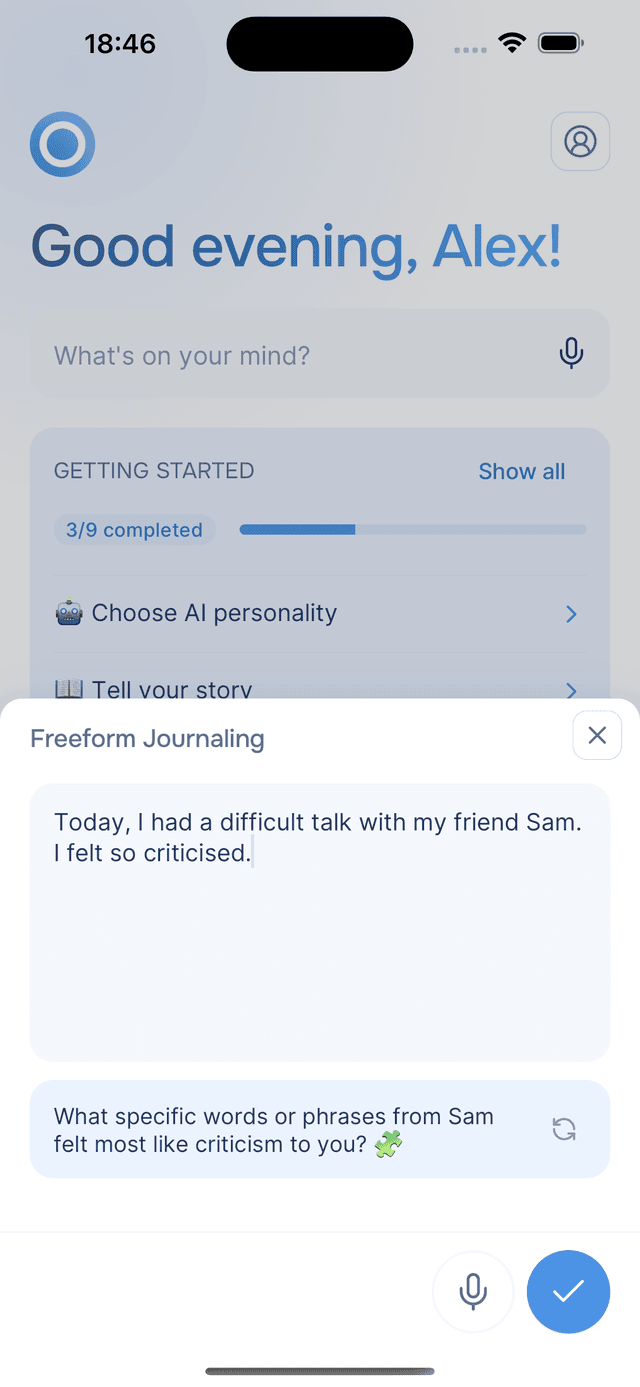
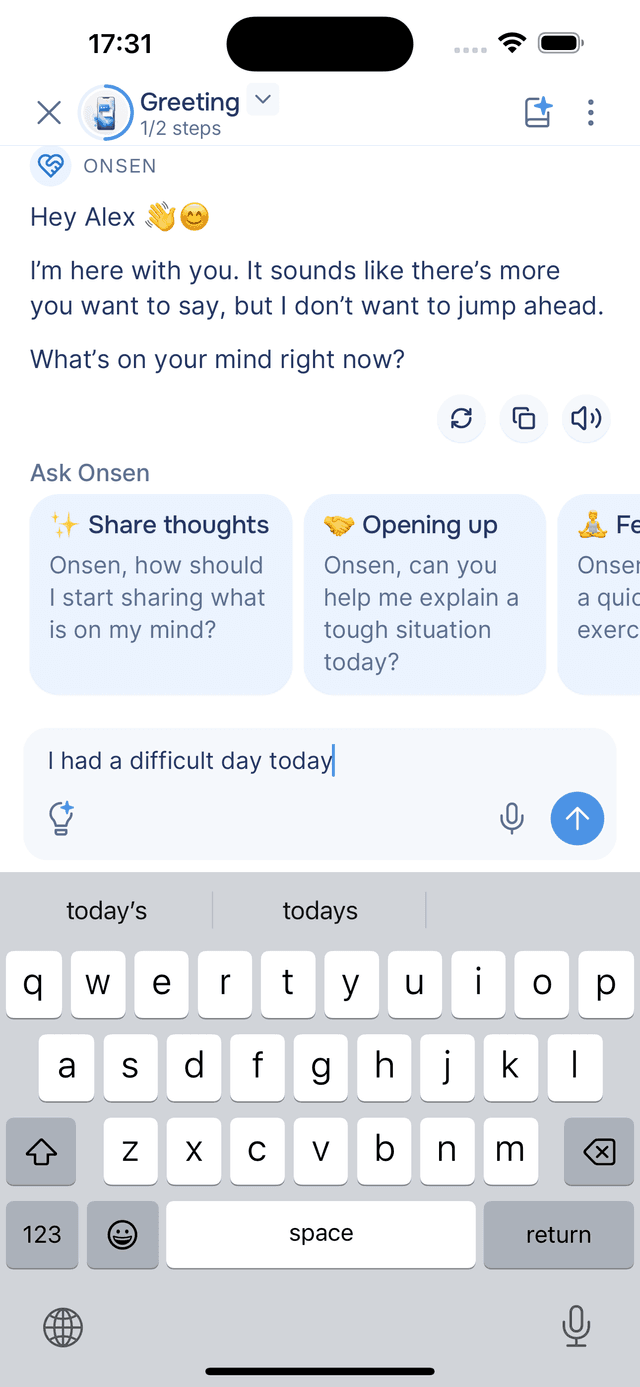
3. Write what you're avoiding
This one is powerful and uncomfortable. If you notice yourself thinking "I don't want to write about that," that's probably exactly what you should write about.
You don't have to solve it. You don't even have to finish the thought. Just getting it out of your head and onto a page changes your relationship with it. Worries that feel enormous and vague inside your mind often feel smaller and more specific once they're written down.
4. Talk instead of type
Some people freeze at a keyboard but can talk for twenty minutes without stopping. If that's you, voice journaling exists for a reason.
Open Onsen, tap the microphone, and just talk. Say what's on your mind. Ramble. Contradict yourself. The app transcribes it, and you can clean it up later, or don't. The point isn't a polished entry. It's getting the thoughts out.
5. Start with how you feel
Sometimes you don't know what to write because you don't know what you're feeling. That's more common than you'd think, especially if you're used to pushing feelings aside to get through the day.
A mood check-in can help. Tap an emoji that roughly matches your state (anxious, peaceful, frustrated, hopeful) and the AI responds with follow-up questions matched to that mood. You don't need words to start. You just need a tap.
What to expect
The first few entries feel weird. You'll wonder if you're doing it right. (You are.) You'll feel self-conscious. (That fades.) You might write three sentences and stop. (That counts.)
After a week, you'll start to notice what keeps coming up. Work. A relationship. Sleep. Money. The same themes, surfacing again and again.
After a month, something shifts. Not dramatically, but you'll catch yourself thinking "I should journal about this" instead of "I should journal." The habit builds because the entries become useful, not because you forced yourself. When we measured this across 18 months of Onsen data, journaling was the single strongest predictor of improvement.
The rules (there's only one)
There's one rule: be honest. That's it.
Spelling doesn't matter. Grammar doesn't matter. Length doesn't matter. You can write fragments. You can contradict yourself. You can write the same thing three days in a row.
Nobody is grading this. Nobody will read it unless you choose to share it. The only person it needs to make sense to is you, and sometimes it doesn't even need to do that.
Start today
Open Onsen. Start a guided journaling session or just open a chat. Write for five minutes. If you get stuck, tap Journaling Prompts and let the AI give you a question to answer.
Five minutes. Today. That's the whole ask.