5 journaling prompts for when you're feeling overwhelmed
You don't need to know what to write. You just need the right question.

You're overwhelmed. Everything feels like too much. Someone told you journaling helps. So you open a blank page and... nothing. The emptiness makes it worse.
The problem isn't you. It's the blank page. When your mind is racing, "write about your feelings" is the least helpful instruction imaginable. You need a specific question to answer, not an open canvas.
These five prompts are designed to take you from "I don't know where to start" to "oh, that's what's going on" in about ten minutes. You don't need to be a writer. You don't need to spell correctly. You just need to be honest.
1. What am I actually feeling right now?
Not "fine." Not "stressed." Those words are so broad they don't mean anything.
Try to get specific. Are you frustrated? Disappointed? Scared? Guilty? Angry at someone in particular? Sad about something specific? Sometimes it's more than one thing at once, and that's okay. Write them all down.
This matters because putting a specific name on what you feel actually changes how your brain processes it[1]. Vague distress stays vague. Named emotions become manageable. "I'm overwhelmed" keeps you stuck. "I'm angry at my boss and scared I'm going to miss the deadline" gives you something to work with.
If you're stuck, try finishing this sentence: "Right now I feel ______ because ______."
2. What triggered this? Describe what happened, just the facts.
Something set this off. Maybe it was a conversation, an email, a thought that spiraled, or just the weight of everything piling up. Write down what actually happened. Not your interpretation of it, not what it means. Just the facts.
"My manager sent an email asking for the report by Friday" is a fact. "My manager thinks I'm incompetent" is a story you're adding on top. Both feel equally real in the moment, but separating them is powerful.
This is one of the most useful skills in psychology: learning to see the difference between what happened and what you told yourself about it. The event is usually smaller than it feels.
3. What's the worst thing I'm telling myself about this?
Everyone has a running commentary in their head. When you're overwhelmed, that commentary tends to go dark. "I can't handle this." "I'm falling behind." "Everyone else has it together."
Write down the worst version. The catastrophic thought. The one that's been looping in the background all day. Getting it out of your head and onto paper does something useful: you can finally look at it instead of just feeling it.
Once it's written down, ask yourself: is this actually true? Or is it the stressed version of reality? You don't have to answer right away. Just noticing the gap between what you're telling yourself and what's actually happening can be a relief.
4. What would I say to a friend dealing with this?
This one works almost every time. Imagine your best friend came to you with exactly what you're going through. Same situation, same feelings. What would you say to them?
You probably wouldn't say "you're a failure." You'd probably say something like "that sounds really hard, but you've handled tough things before." Or "one step at a time." Or "it's okay to ask for help."
Write that down. Then read it back to yourself. That advice? It applies to you too. You already know the compassionate answer. You just need permission to hear it.
5. What's one thing I can do about this today?
Not five things. Not a master plan. One thing.
When everything feels urgent, the most powerful move is to pick one single action and do it. "Reply to that email." "Ask for an extension." "Go for a walk." "Tell someone how I'm feeling."
Write it down. Make it small enough that you can actually do it today. The goal isn't to solve everything. It's to break the paralysis. One action proves to your brain that you're not stuck, and that momentum tends to carry.
Try it right now
Pick any one of these five prompts. Set a timer for ten minutes. Write whatever comes out. Don't edit, don't judge, don't worry about making it coherent. The point isn't to produce something good. It's to get what's inside your head onto a page where you can see it.
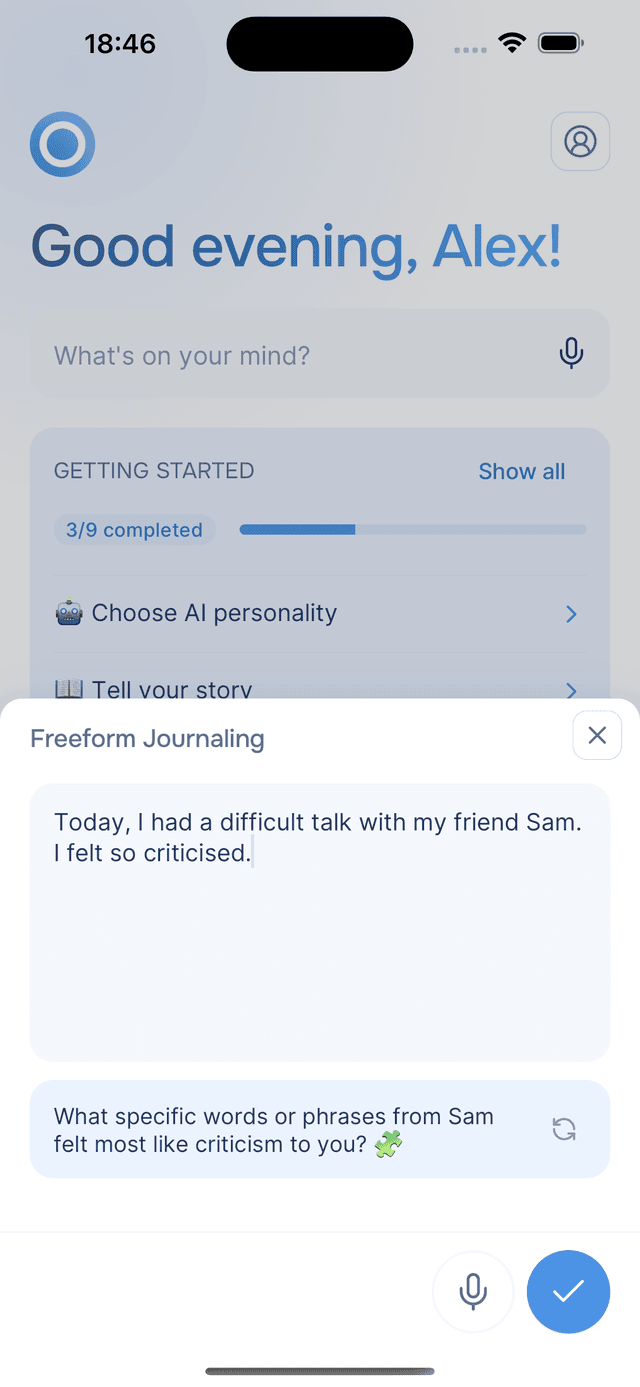
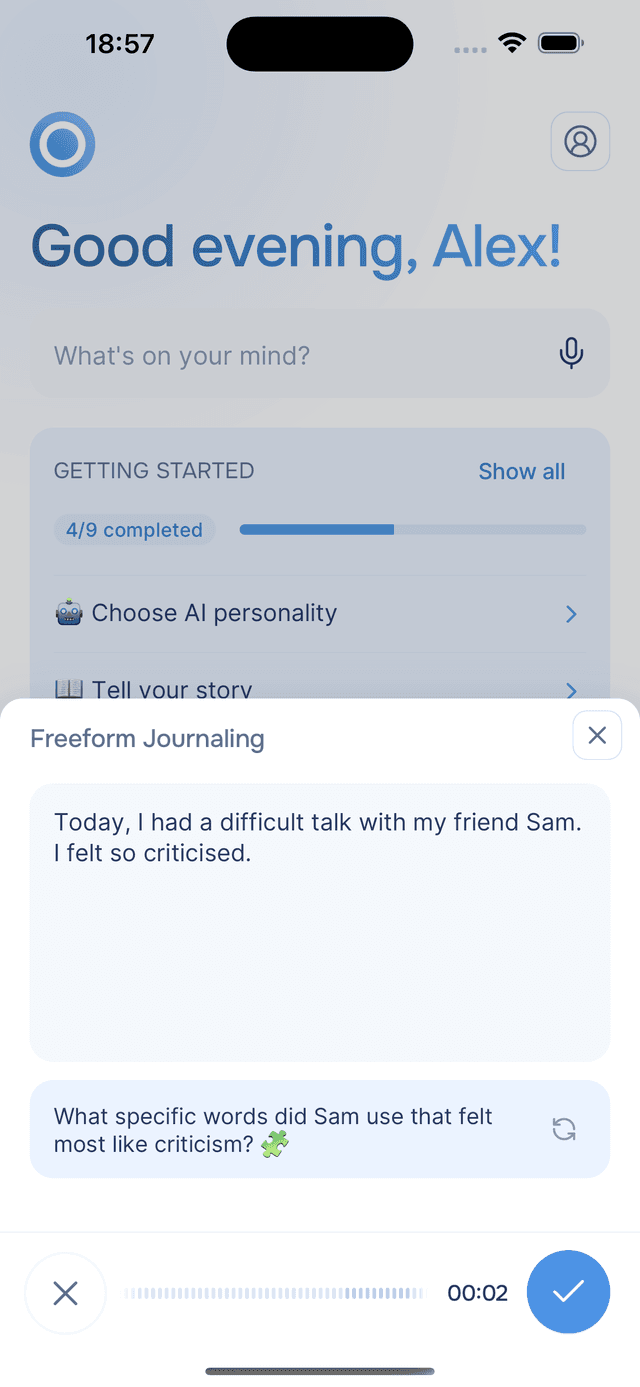
If you want help getting started, Onsen's Guided Journaling gives you prompts like these and asks follow-up questions so you don't have to drive the conversation. You can also just open a chat and talk it out, or use voice input if typing feels like too much.
The research is clear: people who journal regularly see real improvements[2] in how they feel. In our own data, journaling was the single strongest predictor of improvement across happiness and stress. But you don't need to commit to a daily habit. Start with one prompt, one time, ten minutes. See how it feels.
Download Onsen and try Guided Journaling. The AI will ask you the right questions. You just have to show up.