How AI journaling helps with anxiety
You don't need to know what to write. You just need to start.

Anxiety has a way of living in your head. The same worries loop endlessly (about work, relationships, health, the future) and the more you try not to think about them, the louder they get.
Journaling is one of the most effective ways to break that loop. Writing your worries down externalizes them. They move from the chaotic space inside your head onto a page where you can see them, examine them, and often realize they're smaller than they felt.
But here's the problem: most people don't journal. Not because they don't want to, but because they open a blank page and freeze. What do you write? Where do you start? Is this even helping?
AI changes that.
The blank page problem
Traditional journaling asks you to generate everything yourself. The topic, the reflection, the insight: it's all on you. For someone already anxious, that's a lot of pressure on top of existing pressure.
AI-guided journaling removes that barrier. Instead of staring at a blank page, you're met with a question:
Suddenly you have direction. You're not journaling into a void. You're having a conversation with something that's paying attention.
What the research says
The evidence for journaling as an anxiety management tool is strong:
- A 2018 study in the British Journal of Health Psychology found that writing about positive experiences for 20 minutes a day over three consecutive days significantly reduced both state and trait anxiety, with effects lasting at the four-week follow-up
- Psychologist James Pennebaker's decades of research on "expressive writing" shows that putting emotions into words improves psychological and physical health. Separately, neuroimaging research by Matthew Lieberman at UCLA found that labeling your feelings activates the prefrontal cortex, which helps regulate the amygdala, your brain's alarm system
- A meta-analysis of 146 studies (Frattaroli, 2006) confirmed that expressive writing produces modest but consistent improvements across psychological health measures including depression and distress
The mechanism is straightforward: anxiety thrives on vagueness. "I'm worried about everything" is overwhelming. "I'm worried about the meeting on Tuesday because I'm afraid my manager will criticize my presentation" is something you can work with.
How AI makes journaling better
Onsen's AI doesn't just give you a blank page. It does three things that make journaling more effective for anxiety:
1. It asks the right questions
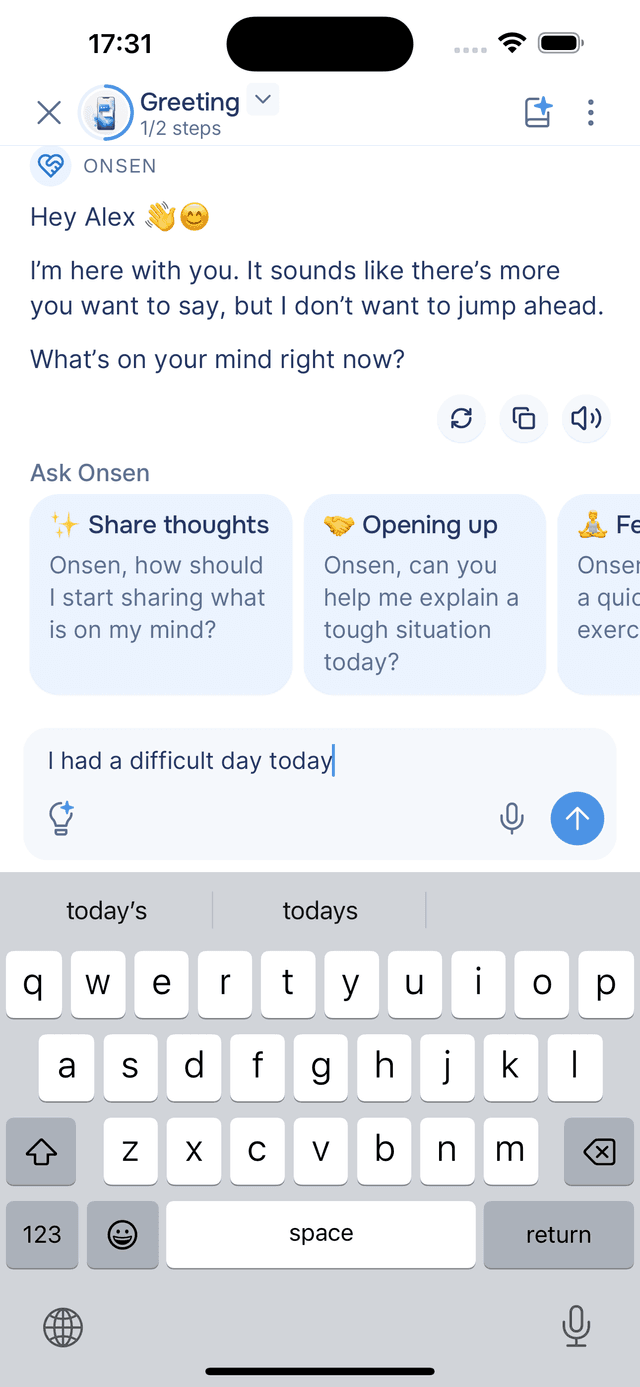
During a guided journaling session, the AI asks follow-up questions based on what you've written. If you say "I'm anxious about work," it doesn't just say "tell me more." It might ask what specifically about work is weighing on you, when the anxiety started, or what you're afraid might happen. These questions help you move from vague dread to specific, actionable concerns.
2. It notices patterns
After a few weeks of journaling, something interesting happens: the AI starts connecting dots you might miss. It might notice that your anxiety spikes every Sunday evening, or that you feel calmer after writing about nature, or that a particular relationship keeps coming up. These pattern insights surface through Pulses, gentle check-ins that reference specific themes from your journal.
3. It offers CBT-based reframing
When you write something like "I'm going to fail this presentation," the AI doesn't just validate your feelings (though it does that too). It might ask: "What evidence do you have that supports that thought? And what evidence contradicts it?" This is a core CBT technique called cognitive restructuring, and it works. For a deeper dive, try the Clear Negative Thoughts experience.
What a session looks like
A typical AI journaling session in Onsen takes about 5-10 minutes:
- Check in: tell Onsen what's on your mind, or select a mood from the mood grid
- Talk it through: write or speak freely about what's bothering you
- Go deeper: the AI asks follow-up questions to help you explore the root of the anxiety
- Reframe: the AI offers a different perspective or a CBT-based prompt
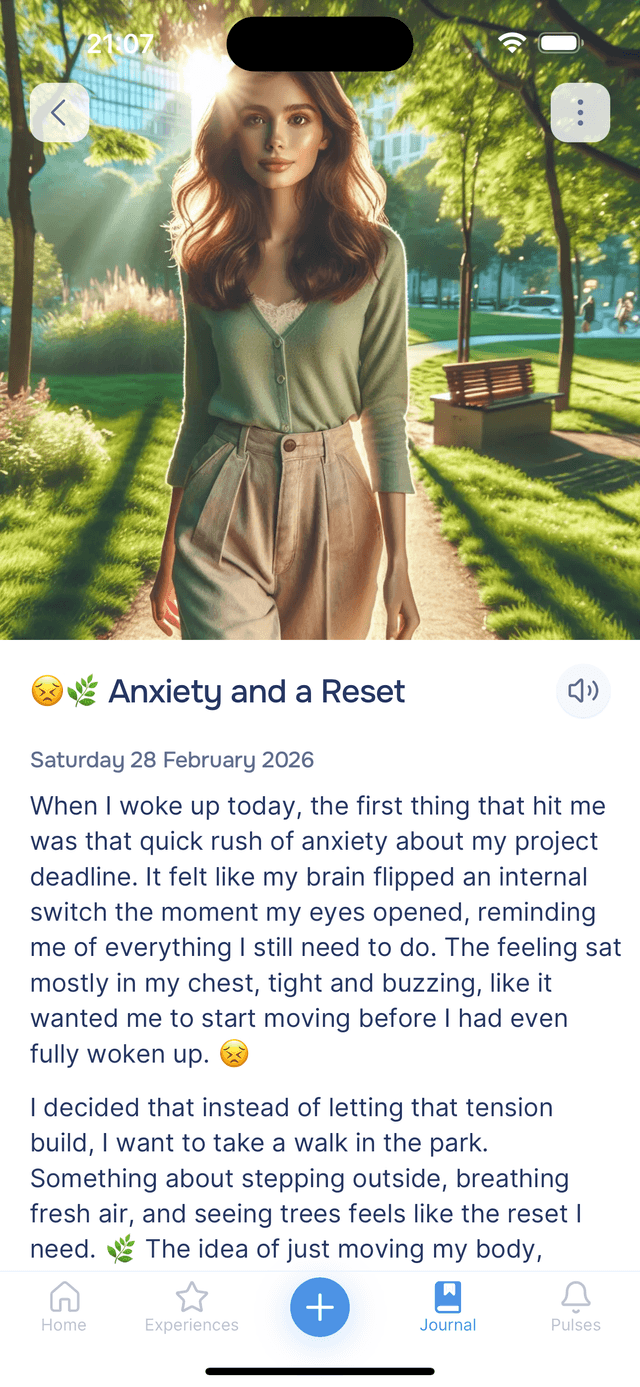
- Save it: your conversation becomes a journal entry with extracted themes and insights
Over time, these entries build a picture of your emotional patterns, one you can learn from and share with a therapist if you choose to. Our own data shows that people who journal consistently report meaningful drops in anxiety and stress.
You don't have to be good at it
The biggest myth about journaling is that you need to be a good writer. You don't. Spelling doesn't matter. Grammar doesn't matter. You can write in fragments, ramble, contradict yourself. The point isn't to produce beautiful prose. It's to get what's in your head out of your head.
If even typing feels like too much, Onsen supports voice journaling. Just talk. The AI transcribes it for you.
Start small
If anxiety is something you deal with, even mildly, try this: open Onsen, check in with how you're feeling, and write for 5 minutes. Don't judge it. Don't edit it. Just let it flow.
You might be surprised at what comes out. And over time, you'll notice something shifting. Not just in your writing, but in how you feel.
Download Onsen and start a guided journaling session. It takes 5 minutes and there's nothing to prepare.