

Stress Tracker
Take the Perceived Stress Scale questionnaire to measure stress levels in your life.

Overview
Stress Tracker is a self-assessment experience based on the Perceived Stress Scale (PSS-10), a validated psychological instrument developed by Sheldon Cohen, Tom Kamarck, and Robin Mermelstein in 1983. It measures how often you have felt unpredictable, out of control, or overloaded in the past two weeks. Onsen guides you through all ten questions, calculates your score, and turns the conversation into a personal journal entry.
- Category: Trackers
- Duration: 5 minutes
- Repeatable: Yes — track your score over time to see trends
How It Works
Step 1 — Quiz
The experience opens with your AI guide introducing the PSS-10 questionnaire: its scientific background, purpose, and what to expect from the ten questions. Your recent journal entries are used to personalize this introduction. Tap Continue when you are ready to begin.
The guide then presents all ten PSS-10 questions as a survey, displayed in shuffled order. For each question you select a response on a five-point frequency scale from Never to Very Often.
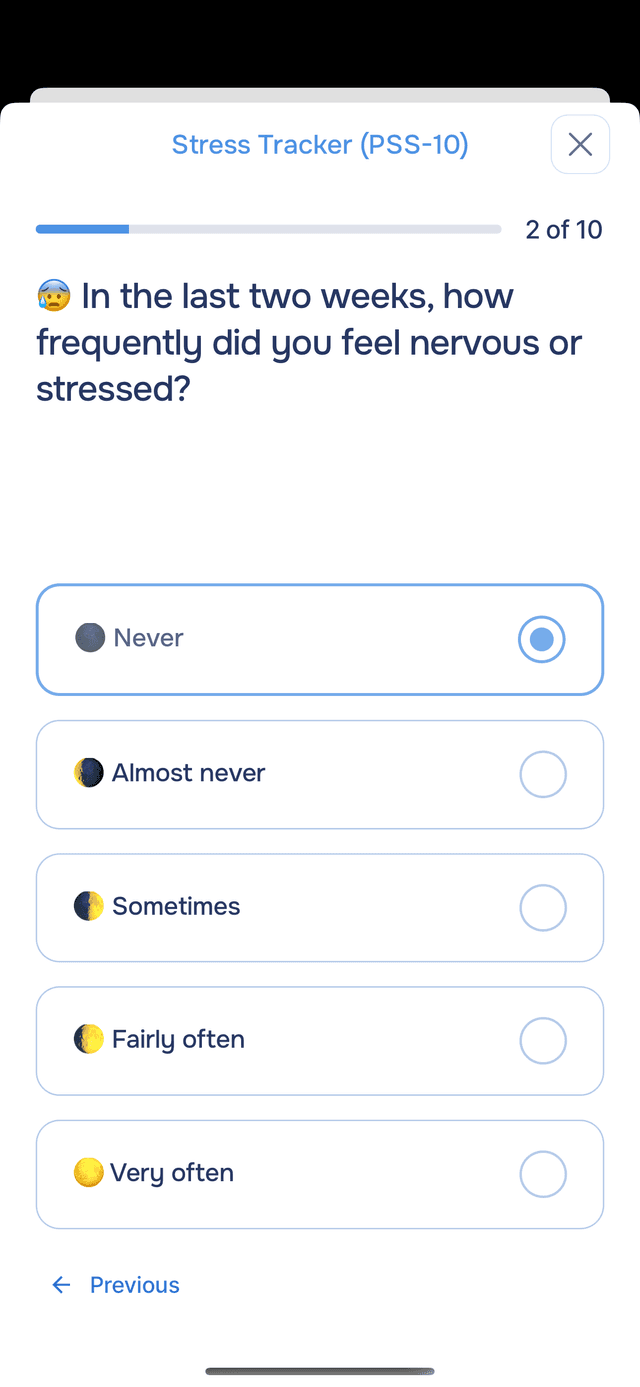
All questions ask how often you have felt a certain way in the last two weeks — covering feelings of being overwhelmed, unable to cope, out of control, or conversely feeling on top of things and confident. Four of the ten questions are phrased positively and scored in reverse.
Once you submit your responses, the guide shares your score on a 1–5 scale and provides a personalized interpretation. It highlights which areas reflect high perceived stress and which reflect areas of resilience, drawing on themes from your recent journal entries. Note that for this scale higher scores indicate more stress: scores above 3.67 indicate high perceived stress, while scores below 2.33 indicate low perceived stress. Tap Continue to Journal to proceed.
Step 2 — Journal
The guide automatically drafts a first-person journal entry based on your quiz conversation. It captures the key themes and your personal reflections in your own tone and style, formatted with markdown and emoji. You can edit the draft before saving. Tap Add to Journal to save the entry to your journal.
Tips
- Think about the past two weeks — all questions refer to this specific window; answer based on that period rather than how you feel right now.
- Read carefully — some questions are phrased positively (such as feeling confident or in control); take a moment before selecting your response.
- High score? — try the Clear Negative Thoughts or Mindfulness experiences to help manage stress with evidence-based techniques.
- Track over time — regular check-ins reveal how life events and your coping strategies affect your stress levels, helping you understand what works for you.