What's new in Onsen 2.16: a garden that grows when you write
The days you show up, and what they add up to.

You wrote something down on Tuesday. Then Wednesday. By Sunday you had written six days, and nothing anywhere said so.
Onsen 2.16 fixes that. There is a new fifth tab called Progress, and it holds the three things about your wellbeing that move slowly: a streak for the days you write, a garden that grows as the streak does, and your check-in scores drawn as a line across the months.
Here is what shipped.
One screen for the slow things
What it does. A fifth slot in the bottom bar, under a leaf.
Why it helps. All three of these change on a scale of weeks. Giving them a screen of their own keeps them out of the way on a day you only want to write, and one tap away on a day you want to know whether anything is moving.
The tab runs from the fastest thing to the slowest: today's streak, then the garden it has grown so far, then your scores across the months. Your notifications moved to a bell in the top right of Home to make room, with the same feed and the same unread badge.
Your streak counts writing, not opening the app
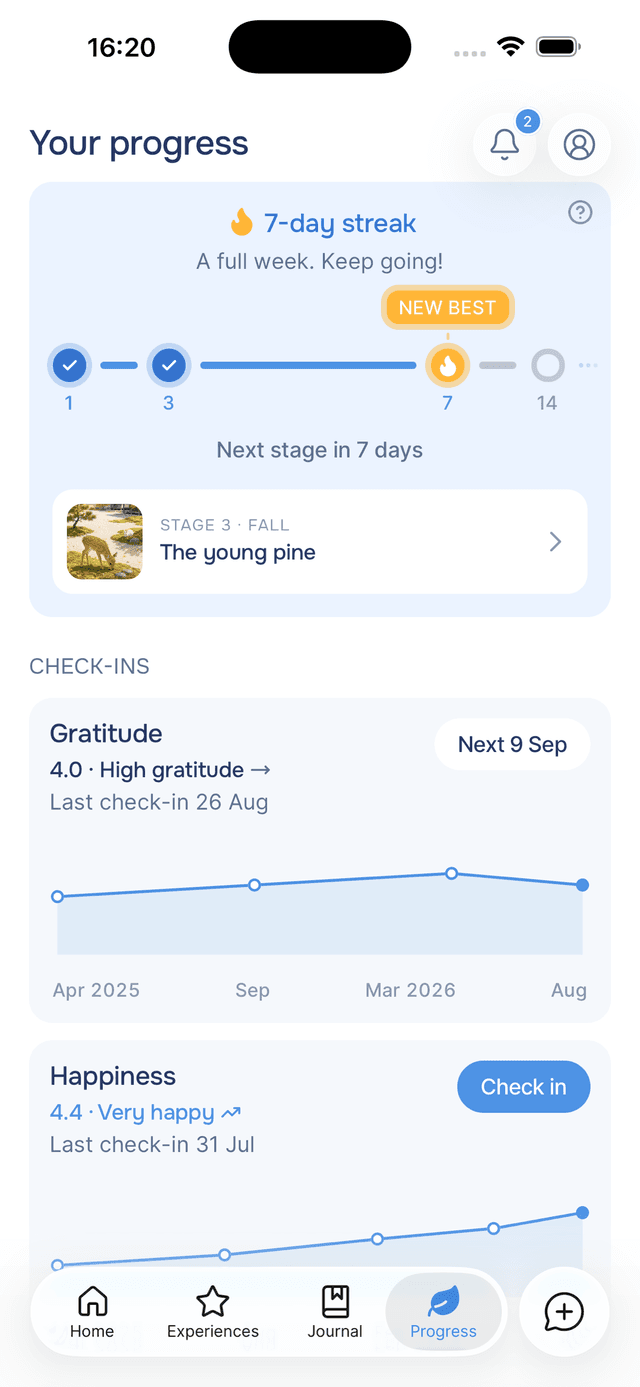
What it does. A flame at the top of the Progress tab, with the number of days you have written something down.
Why it helps. Plenty of apps count the days you opened them. That number tells you nothing. Onsen only counts a day when a new journal entry exists at the end of it, so the streak is a record of thinking rather than of tapping.
Three things get you there, and any one of them is enough:
| What you did | Where it happens |
|---|---|
| Wrote a freeform entry | Freeform journaling, the fastest route |
| Turned a conversation into an entry | Any chat or experience you save to your journal |
| Took a check-in and saved it | A check-in ends in an entry like anything else |
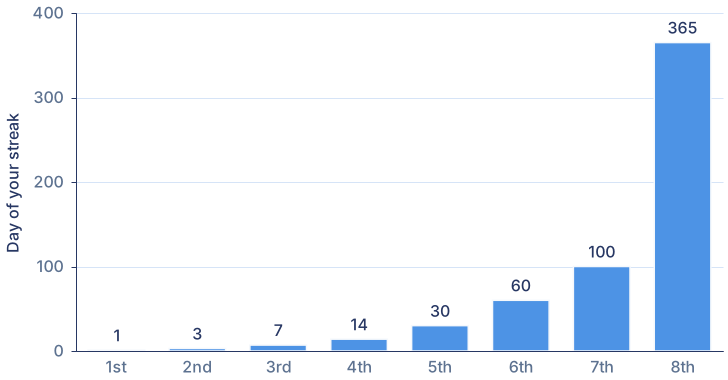
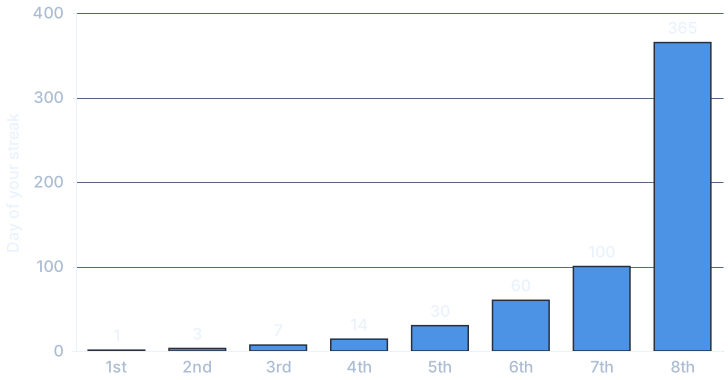
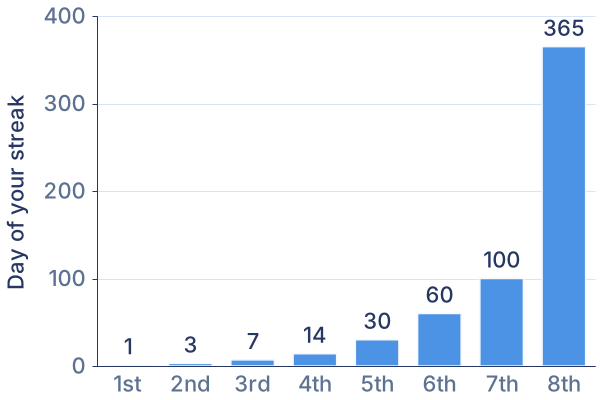
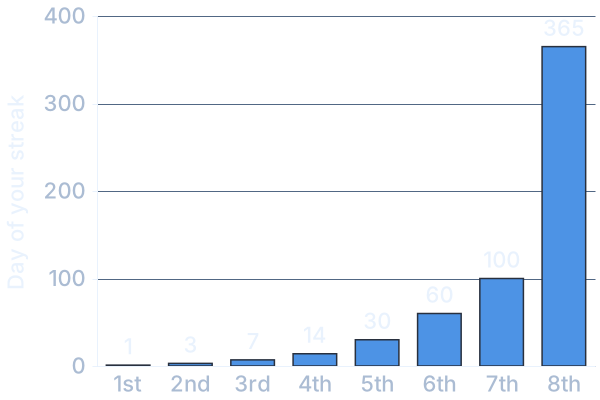
Under the flame runs a path of stones at 1, 3, 7, 14, 30, 60, 100 and 365 days. Four sit on screen at a time and the path slides along as you go. Until today's entry exists the flame stays grey and the path ahead is dashed, so one glance tells you whether the day is done.
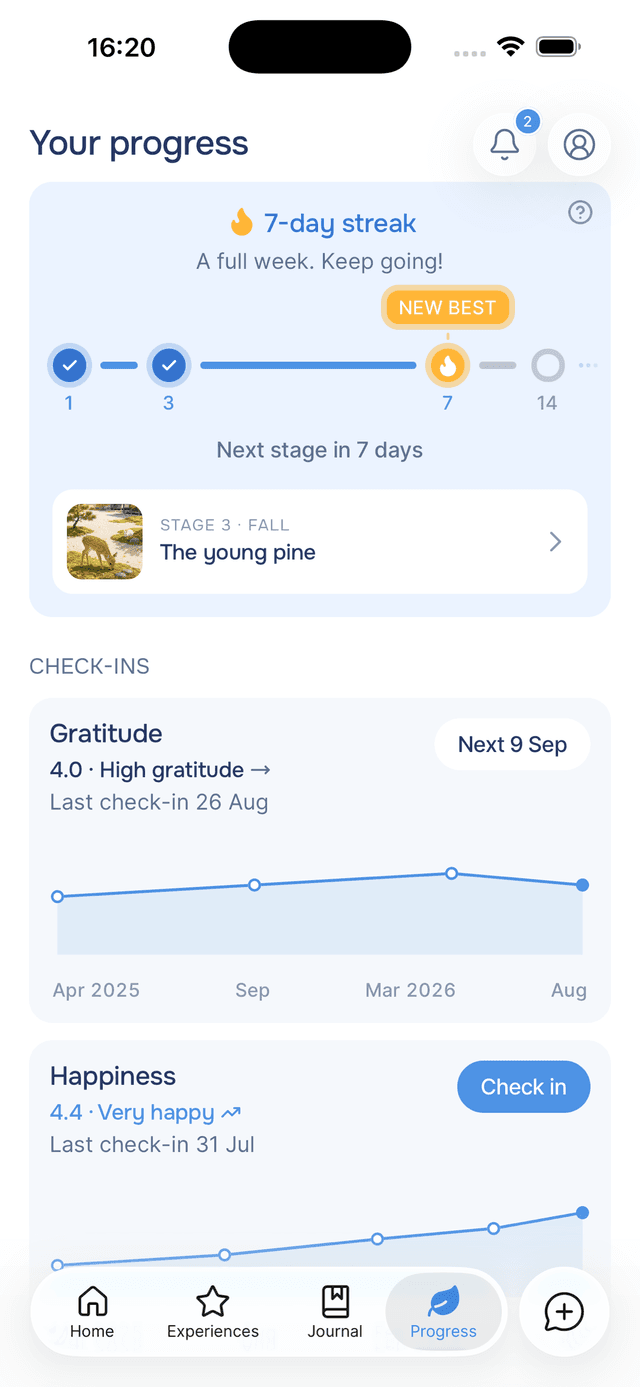
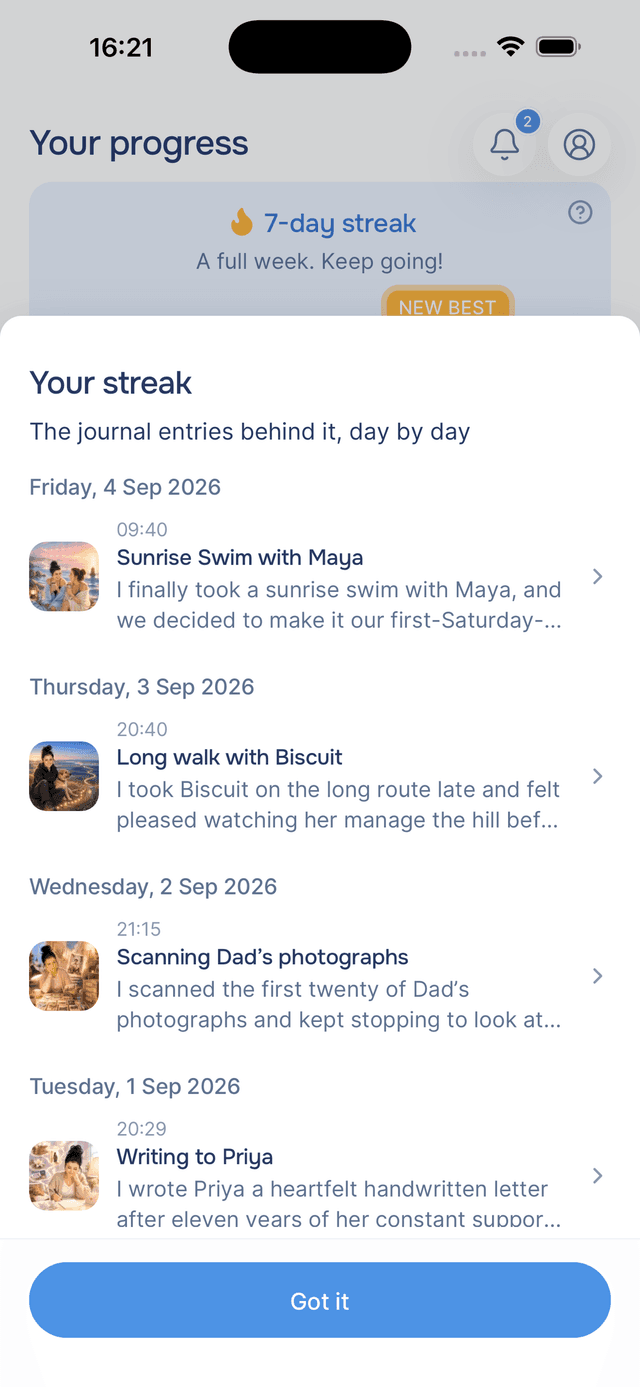
Miss a day and the streak steps back one. Your longest is kept, and so is everything your garden has grown. That second part matters more than it sounds.
A garden that grows when you write
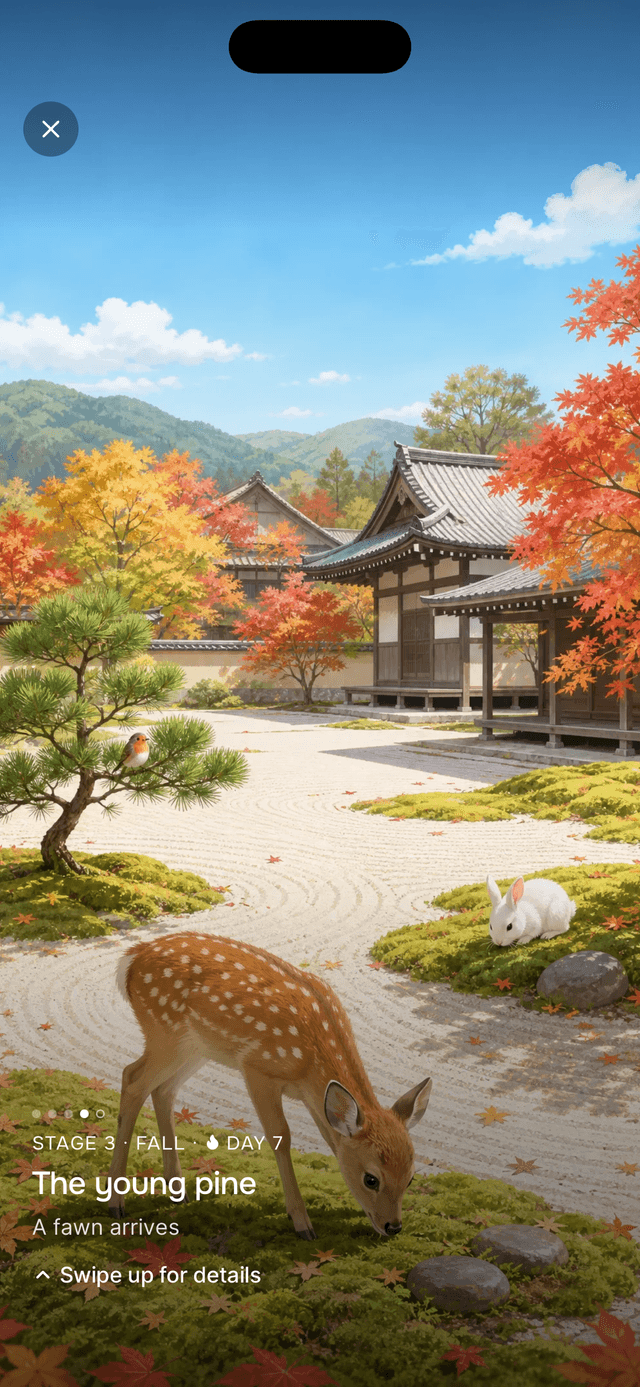
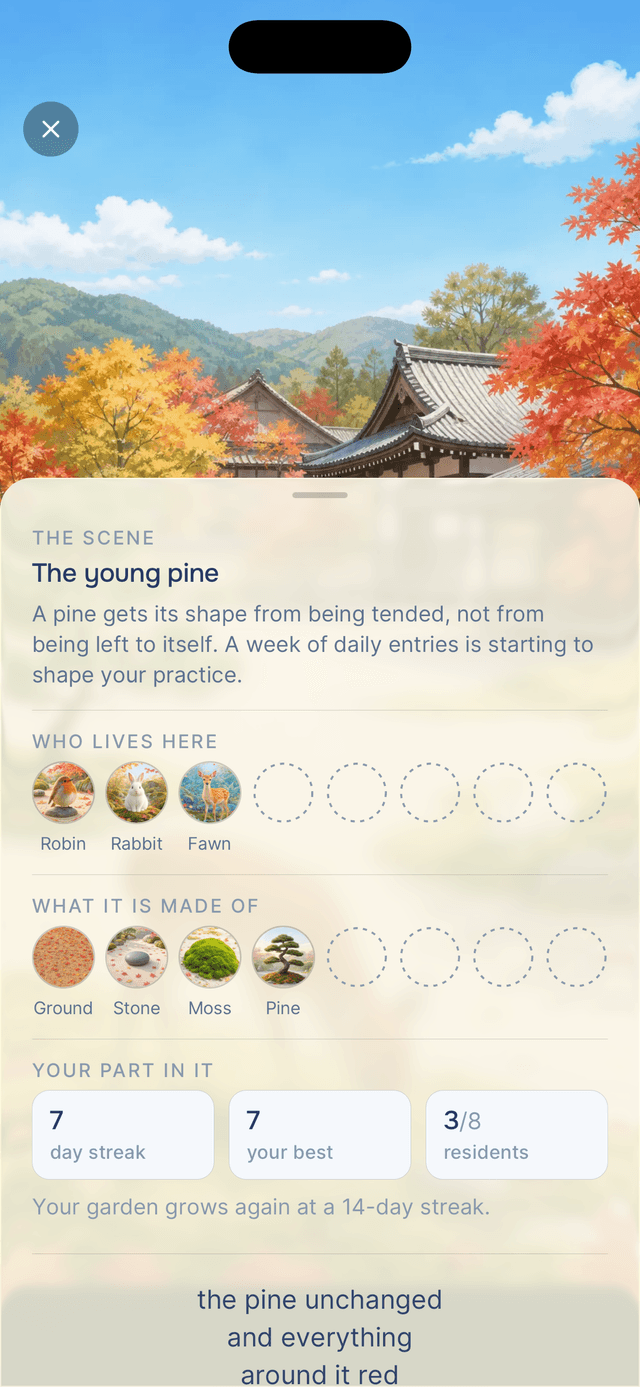
What it does. A Japanese garden, one picture, that gains something new every time your streak reaches a milestone.
Why it helps. Miss a day and the picture does not vanish. It goes quiet, and full color returns as your streak climbs back through each milestone.
A number can dip. A garden does not disappear. Time away costs you days on the count, never the thing you built.
The first stage arrives immediately. Write once and the bare plot becomes raked sand with a single stone in it, and a robin turns up to live there.
So you can see the shape of the run without seeing the contents. The gaps stretch as you go, which is the point. The early stages come quickly enough to be worth chasing, and the last one is a full year away.
Every stage also brings an animal, and once it arrives it stays for good. They sit inside the scene rather than posed in front of it, so finding one is part of looking.
The whole garden wears the current season and changes on its own between Spring, Summer, Fall and Winter. There is nothing to unlock and nothing to set. A garden you earned in July is a different picture in December, which makes it worth reopening on a day you have not written anything.
Check-ins, and the line they draw
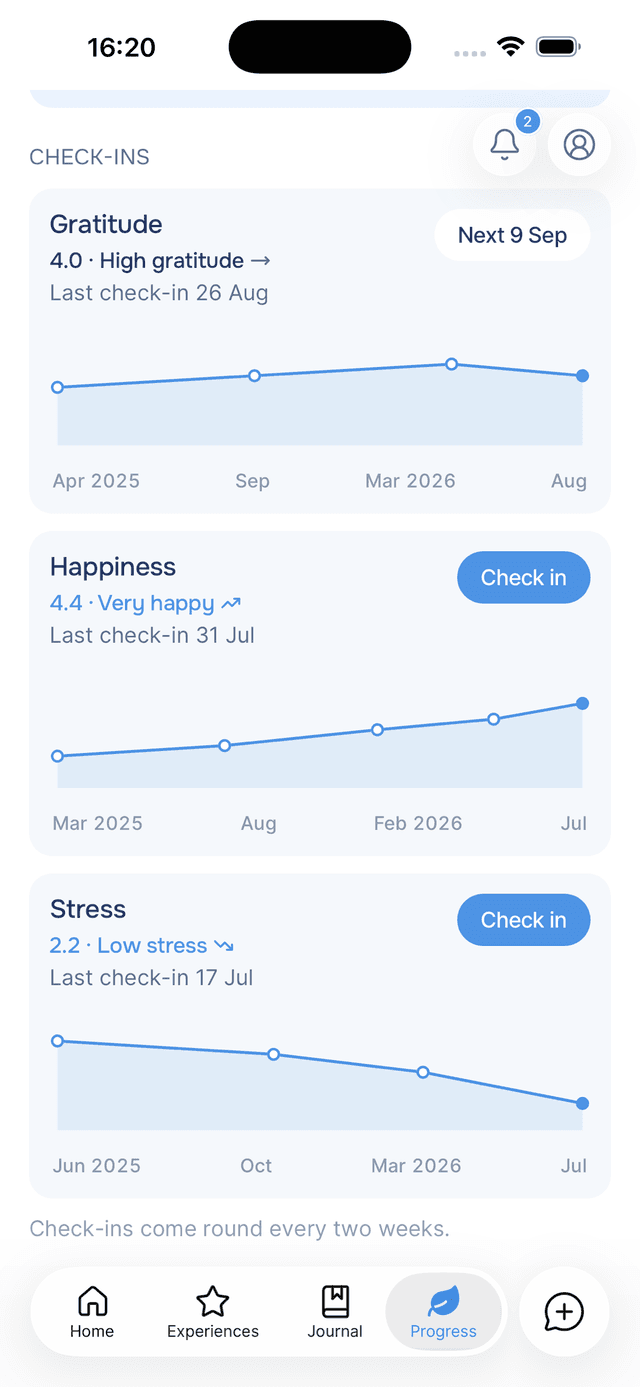
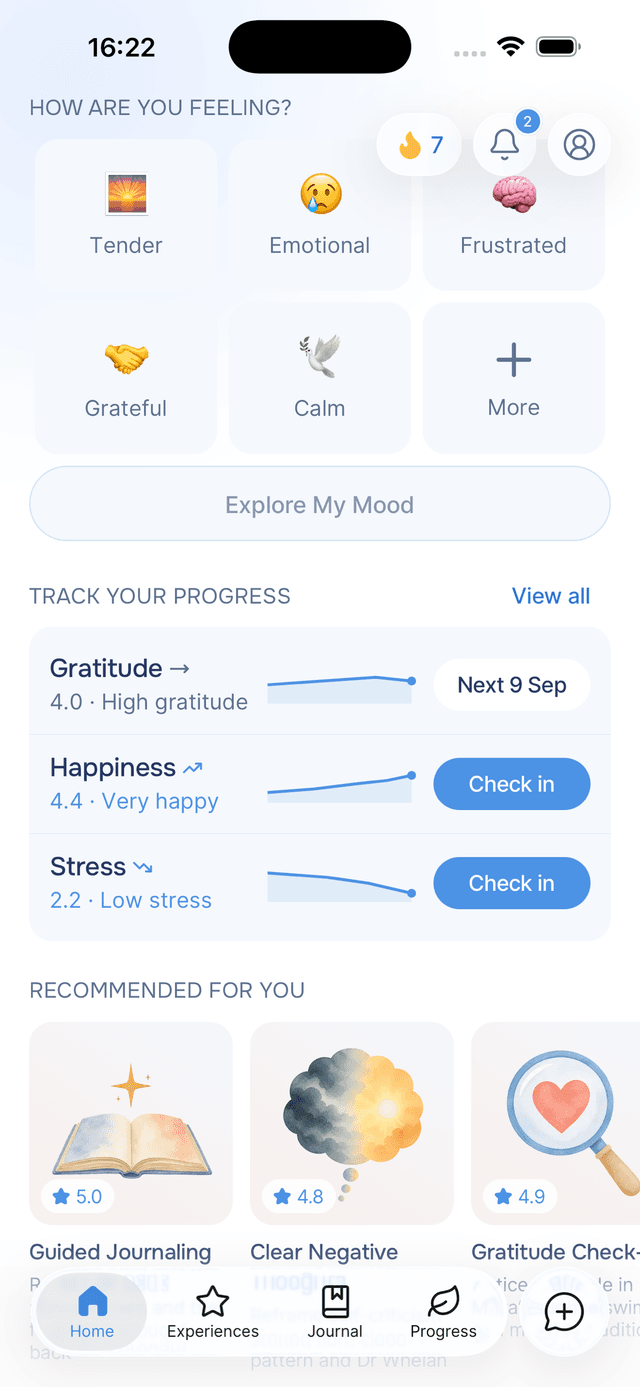
What it does. Three short questionnaires, for happiness, stress and gratitude, each built on a published psychological scale. They used to be called trackers. They come round every two weeks.
Why it helps. One score is a mood. Six scores across three months are a direction, and the direction is the part you cannot feel from inside a Tuesday.
The questions take about two minutes. Your guide gives you the score and what it means, the conversation becomes a journal entry, and the number joins your chart. Nothing is locked. Once you have taken one, its card shows the date the next is due instead of a button, and you can still tap that and go in early.
The card carries the whole history: the latest score with its plain-English band, an arrow for the direction of travel, and a chart plotted against real time so a busy stretch and a quiet one look different.
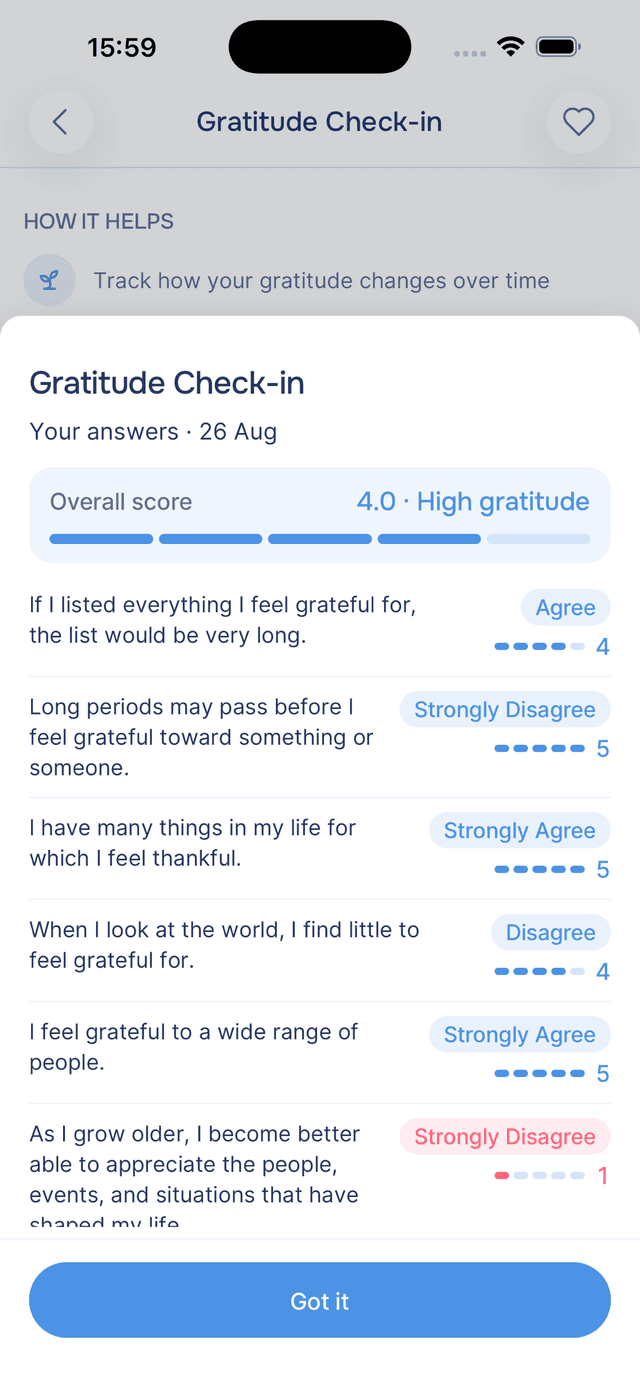
Every answer is kept, not only the total. When a score moves and you cannot think why, open the take and read down it. Often one question did the work. If gratitude is the score you want to move, the science of gratitude covers what actually shifts it.
Home asks for one thing, at most
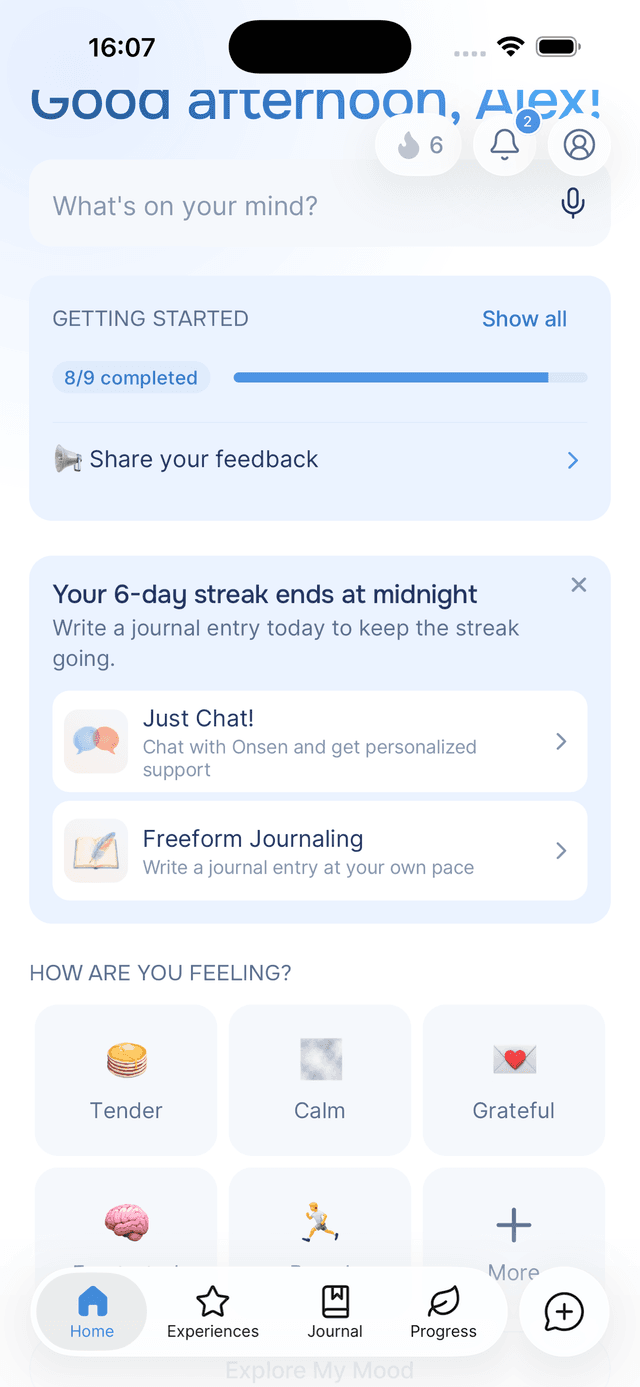
What it does. A single card near the top of Home when there is something worth saying, and a compact list of your check-ins further down.
Why it helps. An app that asks for five things a day gets deleted. Onsen shows at most one card, and on most days it shows none at all.
If a live streak is still unwritten by mid-afternoon, the card says so and offers two one-tap ways to keep it: open the journal, or start a conversation. When a check-in comes round, the card names which one instead of counting them. Dismissing a card means not now rather than never, and it goes quiet for a day or three depending on which kind it was.
There is also a small flame in the header. It sits grey while today is still open and lights the moment an entry saves, which is the whole status in one glyph.
Try it
If you have never kept a journal, a streak is a gentler way in than a blank page. Two lines count. On a day with nothing to say, write that. Our guide to starting a journal has prompts for the evenings the page stays empty.
Download Onsen for free, write one thing tonight, and see what turns up in the sand tomorrow.
Nothing here asks anything of you. It is the record, kept, for the days when it does not feel like anything is changing.