Long-distance relationships and mental health
The loneliness is real. So is the evidence that these relationships can work.
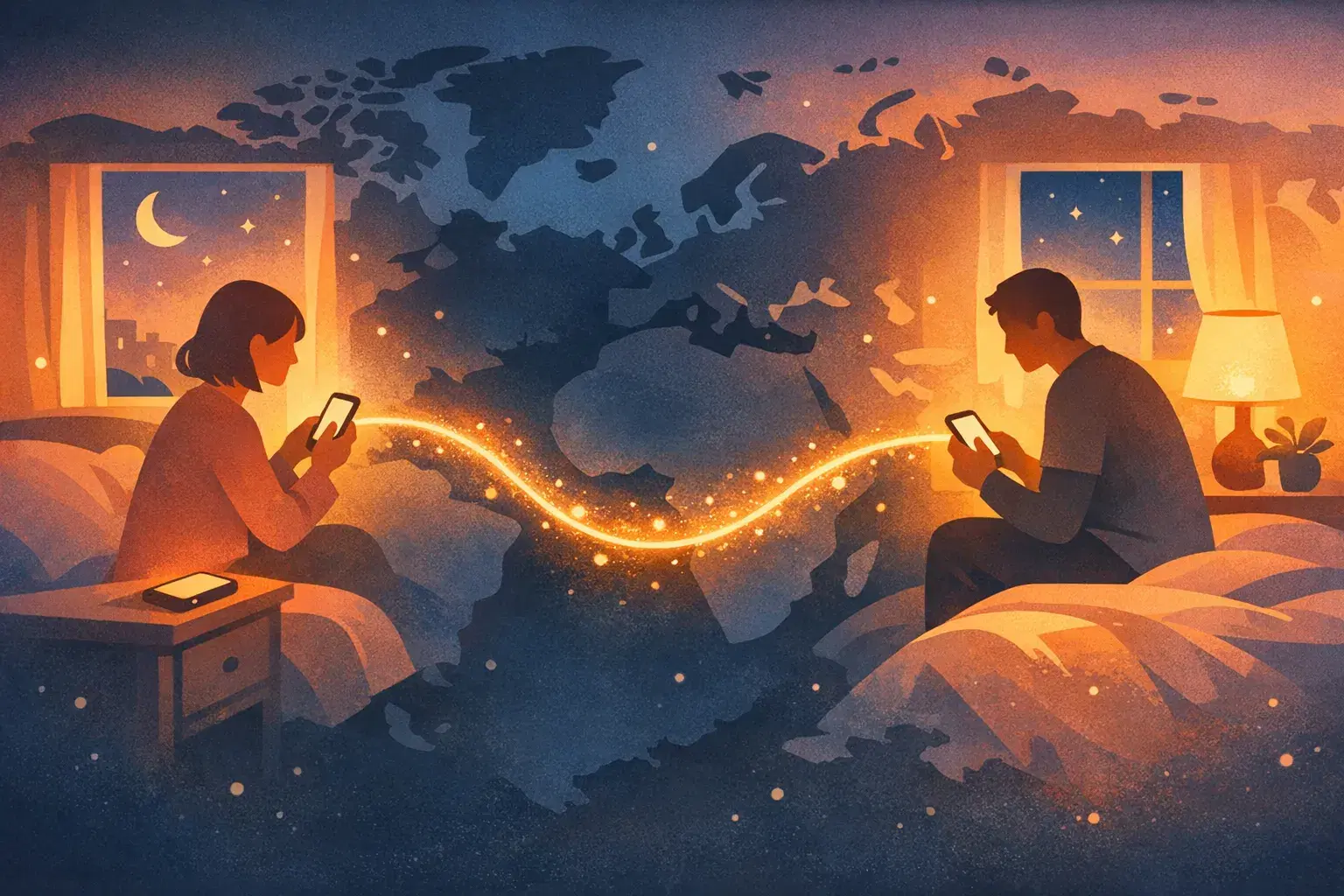
It's 11pm on a Tuesday. You're holding your phone in bed, thumb hovering over a voice note you recorded and re-recorded twice before giving up. It's 4am where they are. You don't actually have anything to say. You just want someone next to you, and the person you want is in another time zone.
That quiet, specific ache is the part of a long-distance relationship nobody warns you about. Not the dramatic goodbyes at airports. The small, ordinary loneliness of a Tuesday. The feeling that your life has a person-shaped hole in it, and the person is fine, but the hole is still there.
If that's the moment you're in, this piece is for you. Good news first: the evidence that long-distance relationships are doomed is much thinner than people think. The bad news first, too: the specific kind of loneliness you feel is real, and it has a structure you can work with.
Distance isn't actually the problem
Here's the finding that surprises most people. When researchers compare long-distance couples to couples living in the same city, the differences are much smaller than you'd expect. A 2015 study found that long-distance partners reported similar satisfaction, intimacy, and commitment to couples who lived together, and in some measures scored slightly higher.[1]
A separate study of daily dating diaries found that long-distance couples reported equal or higher trust and satisfaction than geographically close couples. They also disclosed themselves more openly and idealized their partners more, especially over text.[2]
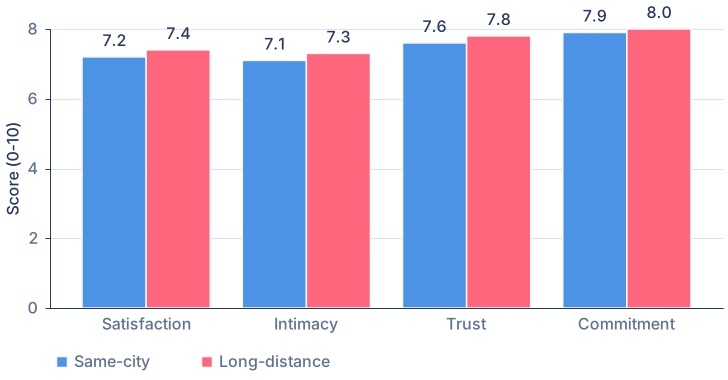
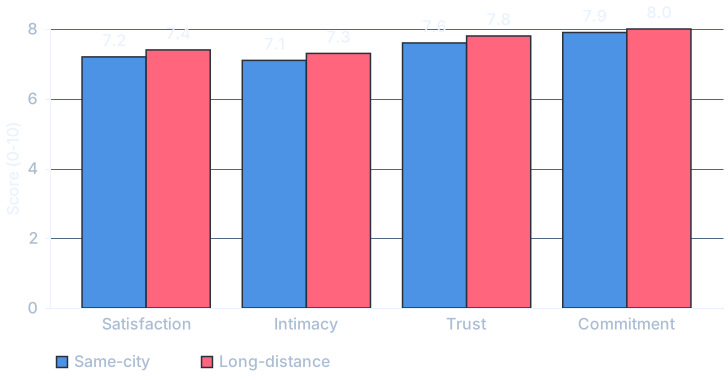
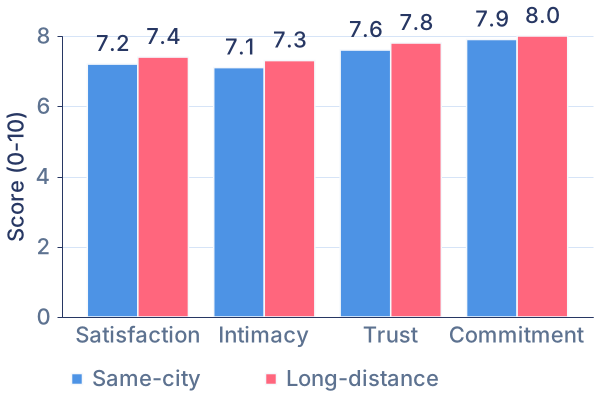
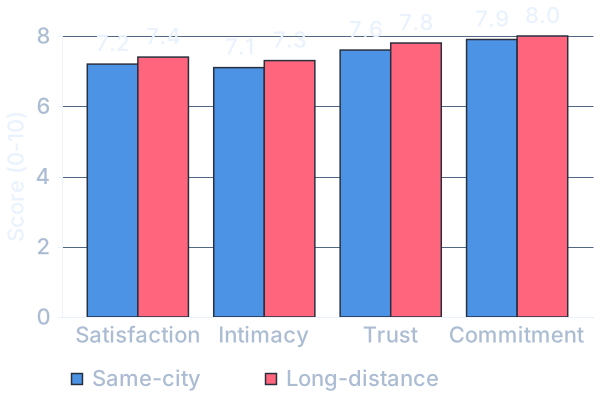
The real gaps are small, but the direction is clear: long-distance couples aren't automatically worse off. What decides whether an LDR wears you down isn't the miles. It's three specific things the miles expose.


The loop above is the engine of most LDR distress. Uncertainty creates anxious thinking. Anxious thinking drives reassurance-seeking, which puts pressure on your partner, which creates more distance, which feeds the uncertainty. This isn't a character flaw — it's what happens when you don't know when the next real hug is.
The three things that actually wear you down
Most long-distance couples who struggle are struggling with some combination of the same three drivers. Naming them helps, because each one has a different fix.
| The driver | The 11pm thought that gives it away | One thing to try this week |
|---|---|---|
| No end date | "I can't even picture us in the same place." | Agree on one concrete marker — a visit date, a rough reunion month. Certainty about one step beats vague "eventually". |
| Missing physical presence | "I just want to lie next to them." | Build a sensory anchor: same playlist on a shared walk, same show on Sunday, a hoodie of theirs on your chair. |
| Text eating your tone | "I can't tell if they're annoyed or just busy." | Switch to voice or video for anything emotional. Keep text for logistics. |
Uncertainty is the biggest of the three. A 2007 study on what predicts LDR distress found that partners who were uncertain about whether they'd ever live in the same city were significantly more distressed, less satisfied, and found their usual coping strategies less helpful.[3] That matches what clinicians see over and over. Couples with a clear reunion plan, even one that's two years out, do much better than couples floating without one.
The physical part is also real, and under-discussed. What LDR couples miss isn't only touch. It's the "intimacy of routine": sharing a meal, bumping into each other in the kitchen, falling asleep to the sound of someone else breathing. These are nervous-system inputs your body genuinely needs. Missing them isn't weakness. It's biology.
Text tone is the quietly corrosive one. A classic study asked people to send short messages over email and rate how accurately the recipient would read the tone. Senders predicted about 78% accuracy. Recipients actually got tone right closer to chance.[4] Your "haha okay" lands as sarcasm. Their "we'll figure it out" reads as dismissive. Over months, the small mis-reads add up to a relationship that feels harder than it is. If you find yourself catastrophizing after a short reply, text tone is often the first domino.
The rituals couples who make it actually use
Here's the second thing that surprises people. Long-distance couples who do well aren't the ones who talk the most. In one 2021 study, the metric that actually predicted long-distance relationship satisfaction wasn't call frequency or video chat. It was responsive, regular texting, where partners replied in a way that made the other feel heard.[5] Frequency of voice calls predicted satisfaction for couples living together, but not for long-distance ones. Video calls didn't predict satisfaction either way.
The takeaway isn't "text more." It's that the couples who make LDRs work have a predictable rhythm, not a high volume.
A few things happen once you have this structure.
First, the Tuesday-night loneliness gets smaller. You stop waiting for a big call to "make up for" the distance, because the distance is being metabolised in small daily doses instead.
Second, you stop watching your partner's social media the way people watch a stock they're worried about. Research on long-distance couples and social network sites finds they spend noticeably more time on their partner's profiles than same-city couples do, and report more jealousy as a result.[6] A ritual replaces surveillance with contact.
Third, anticipation starts doing heavy lifting. When researchers asked people to rate the emotional intensity of the same event while anticipating it versus remembering it, anticipation won. The run-up to something good is often more emotionally rich than the thing itself.[7] A visit booked six weeks out isn't just a visit. It's six weeks of your brain getting small daily doses of "something is coming."
Say it plainly to yourself: "I don't need more contact. I need contact I can count on."
Use video for presence, not conversation
A small but clever study on long-distance couples and video chat found that the couples who used video most successfully weren't using it for "serious conversations." They were using it to share presence. Leaving the camera on while one person cooked and the other did their laundry, watching a movie side by side, sometimes not saying anything for twenty minutes.[8]
The researchers called it "hanging out over video", and noted a surprising side effect: couples who used video this way were less prone to idealising each other. They saw each other's bed-head and frustration at a stubborn jar lid. Those small unflattering moments turn out to be the point, not the problem.
| What most LDR couples do with video | What works better |
|---|---|
| Save it for the "weekly big call" where you're both dressed and trying to be interesting | Leave the camera on while you cook, clean, or work. Forty minutes of ambient presence beats twenty minutes of performance. |
| Use video for hard conversations | Use video for the ordinary stuff. Save the hard conversations for a dedicated "state of us" slot. |
| Both be on your best behaviour | Let them see your bed-head, the dishes you haven't done, the frustration at a stubborn jar. The boring version of you is the one that survives cohabitation. |
That matters because idealisation is the specific risk of long-distance. LDR couples are often more satisfied than same-city couples, but they break up at higher rates when they finally move in together. Roughly a third of long-distance dating couples split within a few months of closing the distance. The reason usually isn't a bad relationship. It's that the version of each other they'd built in their heads was sharper, funnier, and more patient than the real human who left wet towels on the floor.[9]
Low-stakes video time is the cheapest inoculation against this. You want your partner to know you're a normal, slightly irritable, sometimes boring person, long before you move in together.
When the distance is telling you something
Not every long-distance relationship should continue. One of the hardest parts of being in an LDR is that the distance makes it harder to tell "this relationship is hurting me" from "being apart is hurting me."
Here are the signals, from the research and from clinical experience, that the loneliness might be about the relationship itself:
| Signal | What it looks like | What it might mean |
|---|---|---|
| The uncertainty isn't solvable | You've tried to talk about when you'll close the distance. They deflect every time. Months pass. | This specific pattern predicts LDR dissolution more strongly than any other.[3] |
| Communication quality is dropping | Flatness in calls, not fewer of them. Conversations feel like reporting, not connecting. | Emotional distance is growing under the literal distance. |
| Monitoring is replacing trust | Checking their location, scrolling their likes, timing reply delays. | Surveillance tends to rise as relationship quality falls, not the other way round.[6] |
| LDR stress is spilling into the rest of life | Work, sleep, and friendships bending around the relationship's uncertainty. | The relationship is costing more than it's returning right now. |
| You've stopped being honest | Protecting them from your sadness because you don't want to "make the distance harder." | Something has gone quiet that needs to be loud again. |
If you recognise yourself in several of these, you are not automatically in the wrong relationship. You might be in a relationship that needs a hard conversation. Long-distance couples therapy is a real option (most therapists now do it over video, including for couples in different countries). Our piece on communication in relationships covers the patterns therapists actually recommend, most of which work the same whether you're in the same room or 3,000 miles apart. You may also benefit from working on your own negative self-talk patterns before you start blaming the distance, because LDRs amplify whatever was already there.
A note on military and involuntary separations. Research on US Army wives found that women whose partners were deployed received significantly more diagnoses of depression, anxiety, sleep problems, and adjustment disorders than women whose partners stayed home, and the longer the deployment, the bigger the gap.[10] If your distance is not chosen, and especially if there is no clear end date, you are dealing with a harder version of the same problem. You need more support, not more stoicism.
How Onsen can help
The hardest part of a long-distance relationship isn't the goodbyes. It's the 2am moments when you want to talk but can't wake them, the 11pm spirals after a text lands weird, the Sunday afternoon where you just want to say "I miss them" out loud without turning it into a whole thing on a video call.
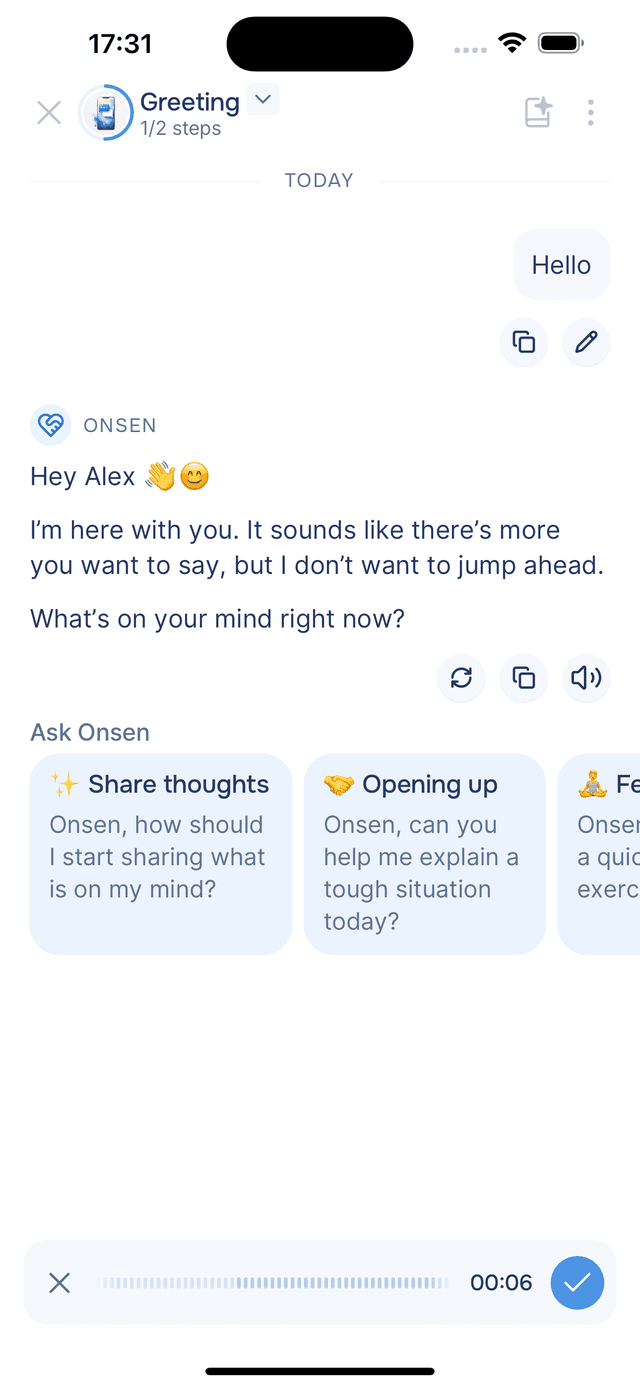
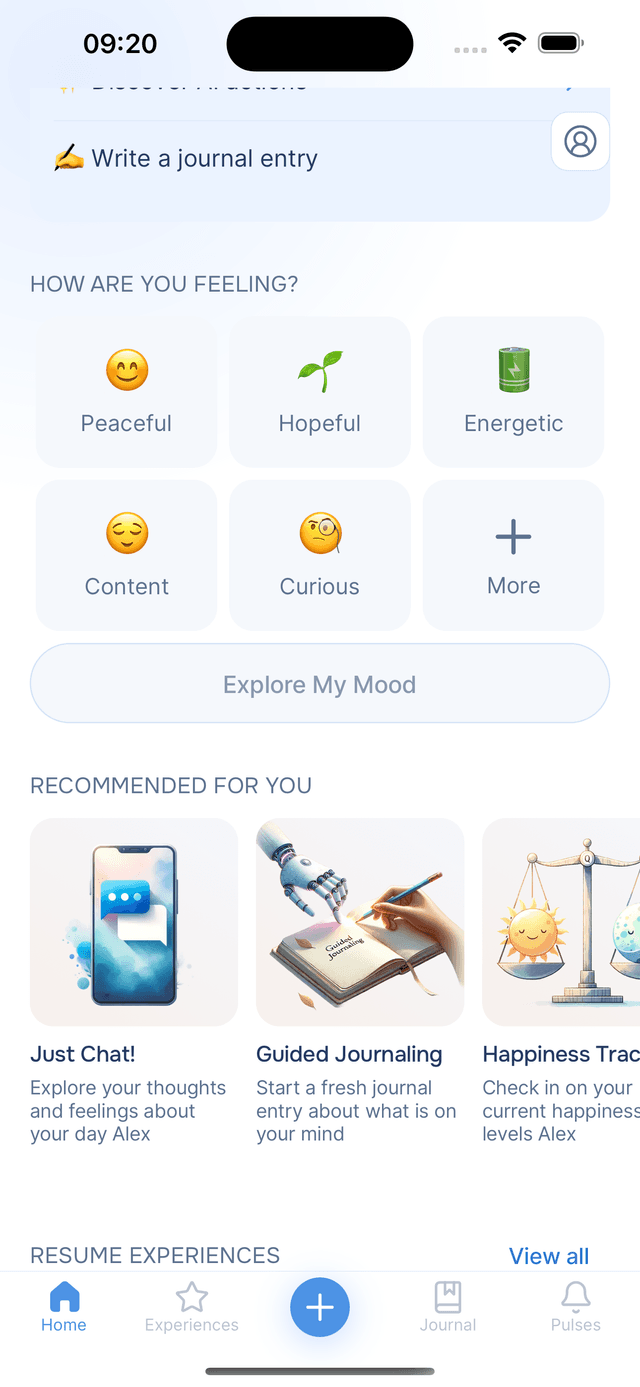
Onsen is built for exactly that gap. You can talk to your AI guide by voice or text at 2am without guilt, track your mood across weeks to see what the distance is actually doing to you, and journal through the specific kind of loneliness you don't want to dump on your partner. Our Pulses check in on you when a pattern shows up, like getting quieter on the days right before a visit.
It's not a replacement for the person you miss. Nothing is. But it can hold the 11pm ache so you're not carrying it alone, so when you do get on a call with your person, you're showing up with the full version of you instead of the compressed version that's been white-knuckling through the week. Download Onsen for free.
The distance is real. So is the loneliness that comes with it. But the evidence is pretty clear: couples who build predictable rituals, share the mundane parts of their life, and keep the uncertainty small don't just survive the distance. A lot of them come out the other side stronger than the ones who never had to do this work at all.
Distance isn't the problem. Unpredictability is. Fix that, and most of the rest follows.
Sources
- 1.Dargie, Blair, Goldfinger & Pukall (2015). “Go long! Predictors of positive relationship outcomes in long-distance dating relationships.” [PubMed ]
- 2.Jiang & Hancock (2013). “Absence makes the communication grow fonder: Geographic separation, interpersonal media, and intimacy in dating relationships.” [academic.oup.com ]
- 3.Maguire (2007). “Will it ever end? A reexamination of uncertainty in college student long-distance dating relationships.” [DOI ]
- 4.Kruger, Epley, Parker & Ng (2005). “Egocentrism over e-mail: Can we communicate as well as we think?.” [PubMed ]
- 5.Holtzman, Kushlev, Wozny & Godard (2021). “Long-distance texting: Text messaging is linked with higher relationship satisfaction in long-distance relationships.” [PMC ]
- 6.Billedo, Kerkhof & Finkenauer (2015). “The use of social networking sites for relationship maintenance in long-distance and geographically close romantic relationships.” [PubMed ]
- 7.Van Boven & Ashworth (2007). “Looking forward, looking back: Anticipation is more evocative than retrospection.” [PubMed ]
- 8.Neustaedter & Greenberg (2012). “Intimacy in long-distance relationships over video chat.” [dl.acm.org ]
- 9.Stafford, Merolla & Castle (2006). “When long-distance dating partners become geographically close.” [journals.sagepub.com ]
- 10.Mansfield, Kaufman, Marshall, Gaynes, Morrissey & Engel (2010). “Deployment and the use of mental health services among U.S. Army wives.” [PubMed ]