Living alone and mental health
A quiet apartment isn't a diagnosis. But some quiets are louder than others.
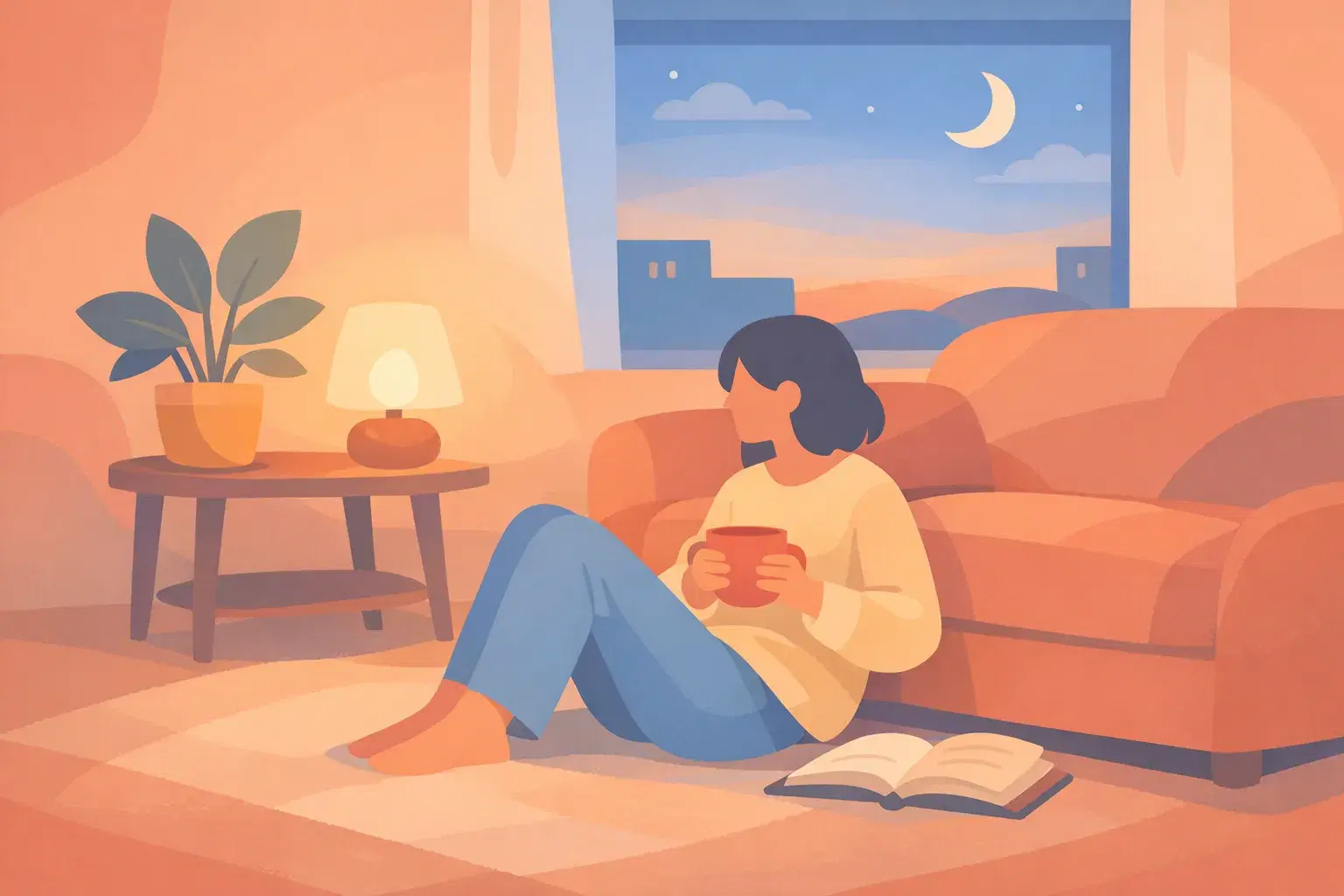
It's Sunday evening. You walked in, closed the door, and the place did that thing it does. It got quiet in a way that felt heavier than it should. Not a crisis. Not unbearable. Just present.
You put on music to fill the space. You half-opened a text to someone, then closed it. You looked around your perfectly fine place and wondered, for the second time this month: is this bad for me?
There are 38.5 million people living alone in the US[1], about 29% of all households. Across the EU, single-adult households make up more than a third[2]. In Japan, it's 34% and rising[3]. You are not a demographic outlier. You are part of the biggest quiet shift in how humans live.
The research on what that does to your mental health is real, and it's more nuanced than the headlines. So here is the honest version.
Living alone isn't the problem. Feeling alone is.
The first thing to untangle is the language. "Living alone," "loneliness," and "social isolation" get mashed into the same sentence constantly, and they're three different things.
- Solitude is a living arrangement or a chosen moment. You are physically alone, and it's fine or actively good.
- Loneliness is a feeling. It's the gap between the connection you have and the connection you want. You can feel it in a packed bar.
- Isolation is objective. A small network. Long stretches without meaningful contact. It can happen to someone who lives with five people.
| What it is | How it usually feels | What usually helps |
|---|---|---|
| Solitude (you, on your own, by choice) | Quiet. Often calm. Space to think. | Protecting it. Using it. Noticing when it's slipping into something else. |
| Loneliness (a felt gap in connection) | Achy. Restless. The draft text you didn't send. | Reaching toward one specific person. Naming what you actually want from them. |
| Isolation (objectively few contacts) | Numb. Flat. Days that blur. | One small, scheduled point of contact. A standing call. A walk past a shop you know. |
This distinction matters because the research finds very different things about each one. A 2015 review[4] pulled them apart: social isolation raised mortality risk by 29%, loneliness by 26%, living alone by 32%. Three separate constructs, three separate effects.
And a 2024 study of older adults in Tokyo[5] found something almost everyone misses: people who lived alone but were not socially isolated showed no increased mortality risk at all. The risk only appeared when living alone combined with isolation.
In other words: living alone isn't what's hurting you. What might hurt you is if where you live quietly becomes the whole world.
What the research actually says
Let's talk about those headlines for a second. "Living alone increases your risk of death by 32%." "Loneliness is as bad as smoking 15 cigarettes a day." You've seen them. They're mostly true. They're also mostly useless if you actually live alone, because they tell you to feel doomed and don't tell you what to do.
Here is the more grounded version.
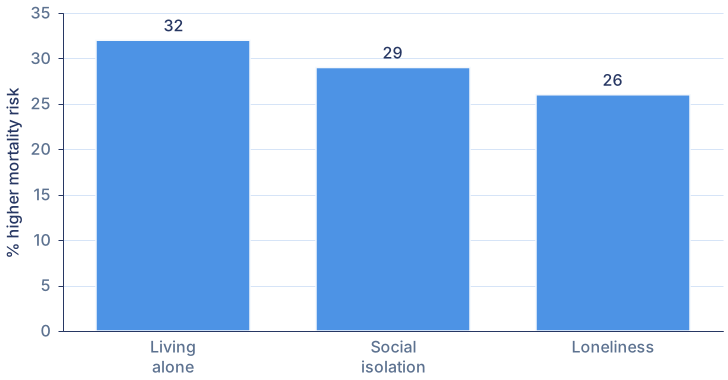
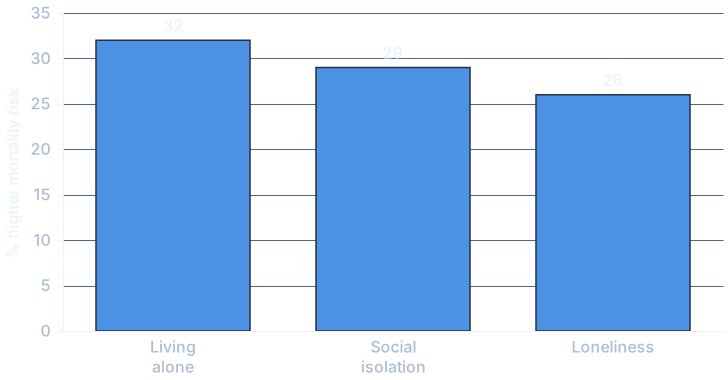
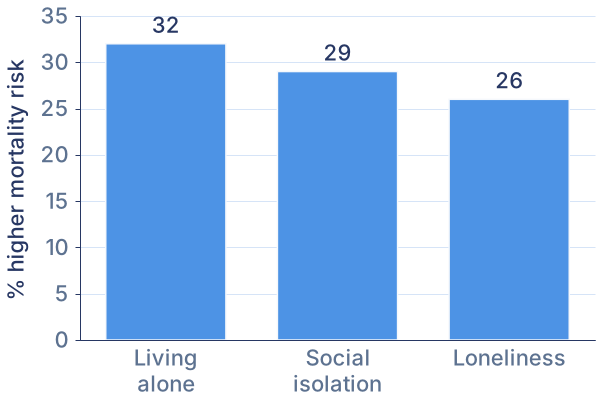
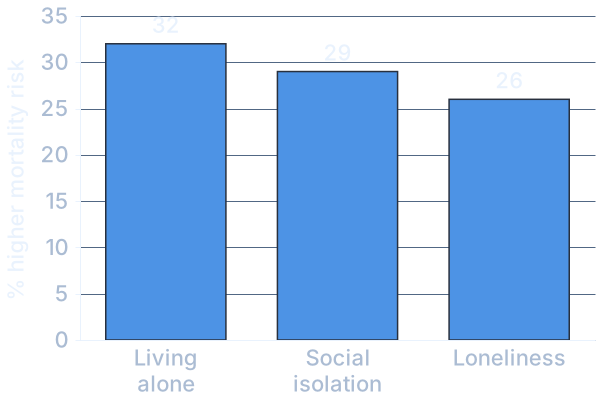
Three separate constructs, three separate effects. The same research team concluded that social risk factors like these are on the same order as well-established lifestyle risks like smoking[6]. That's real. It's also not a death sentence. Billions of people live with some of those risks and live long lives.
More recent research[7] has narrowed that number further, to about 21% elevated risk, and shown it varies a lot by age, country, sex, and whether you have chronic illness. For a healthy 30-year-old with friends and a standing call once a week, the number is closer to "basically nothing." For a 75-year-old widower with no visitors, it's much higher.
Mental health follows a similar shape. A 2019 analysis[8] of three English mental health surveys (covering 20,503 adults) found that people living alone were about 60–90% more likely to have a common mental disorder. But the same study found that loneliness explained 84% of that association. Not the living arrangement. The felt gap.
If you live alone and you don't feel lonely, the data says most of the risk isn't yours. If you live with a partner and feel unseen most nights, the risk is closer to yours than you'd think. It's the feeling, not the floor plan.
Why the quiet gets loud
There's a specific loop a lot of solo-livers know, even if they've never named it. It goes like this.


The loop isn't depression or pathology. It's what happens when a brain built for other people hits a room with no other people, and starts generating its own noise to fill the quiet. Researchers call one version of this "solitude inertia"[9] — getting stuck in solitude even after it stops helping. People high in solitude inertia had more depressive symptoms eight weeks later than people who didn't.
Short-term solitude is useful. Long, unbroken stretches of it tend to compound.
Living alone amplifies the loop in a few specific ways:
- Nothing to pull you out. A housemate banging around the kitchen interrupts the spiral whether you want them to or not. An empty place lets it run.
- Decision fatigue on connection. Every social contact has to be initiated. There's no "well, they're home, I'll just talk to them."
- Irregular rhythm. A 2016 cross-cultural study[10] of over 8,000 people found that social rhythm irregularity predicts worse mental health. Eating at random times, sleeping at random times, no shape to the week. That's more likely when nobody else's schedule bumps into yours.
If the voice in your head is telling you you're wasting your evening, or that everyone else is doing something and you aren't, our guide to challenging negative self-talk has the tools. It's worth knowing the voice isn't your life narrating itself. It's the loop.
What actually helps (tonight, this week, this year)
The research on what helps loneliness is surprisingly specific. A 2011 meta-analysis[11] compared four strategies for reducing loneliness: more social contact, better social skills, more social support, and addressing unhelpful social thoughts. The one that worked best by a wide margin was the last one. Changing the story in your head about connection, not just the logistics.
That matches what the rest of the literature shows. Living well alone is less about packing your calendar and more about building a few load-bearing rhythms. Here's a practical tiering.
| Timeframe | One move | Why it works |
|---|---|---|
| Tonight (5 min) | Name which one it is — solitude, loneliness, or isolation — then do the move that fits. Or say one thing out loud to break the silence. | Naming changes what you do next. Vocal cords in a room shift the feel of the room. |
| This week | Pick one standing anchor — a Tuesday call, a Thursday class, a Saturday café. One, not three. | "Third places"[12] carry a lot of the social weight a shared household used to carry. |
| This year | Invest in your connection layer as a project, and watch for warning signs (poor sleep, self-neglect, weeks nobody would notice you disappeared). | Solo livers are more likely to build social lives — but only the ones who actively build it. |
Tonight (5 minutes)
- Name which one it is. Solitude, loneliness, or isolation. The word you pick changes what you do next. Solitude: protect it. Loneliness: send one specific message to one specific person. Isolation: schedule one thing for this week before you go to bed.
- Say one thing out loud. Voice journaling or a single sentence to the ceiling. Your vocal cords existing in a room shifts the feel of the room more than you'd expect.
- Break the loop physically. Stand up, open the door, step onto the balcony or the hallway. Anything that interrupts the empty-evening → wandering-mind → scrolling chain. The loop needs momentum; you only need to cost it a few seconds.
This week (one structural thing)
- Pick one standing anchor. A Tuesday call with a friend. A Thursday class. A Saturday coffee at the same café. Not three. One. You're building a rhythm, not a calendar. Research on "third places"[12] (the café or bar or gym where you're a regular) shows these low-stakes recurring contacts carry a lot of the social weight a shared household used to carry.
- Tell one person something real. Not a crisis. Just something you actually feel. "This month has felt heavier than usual." Bond strength grows at the edge of what you'd normally say.
This year (one rebuild)
- Invest in your connection layer. Solo livers are actually more likely to eat out, exercise, and join social groups than people who live with partners[13]. But only the ones who actively build it. It doesn't happen by accident when you live alone. It has to be a project.
- Notice the warning signs. Disrupted sleep, declining self-care, long stretches of not wanting to see anyone, no one who'd notice if you went dark for a week. These are the signs the loop has stopped being occasional and started being the weather. If three or more are true for more than a month, this is the moment to reach toward a therapist, a GP, or someone who knows you. Understanding depression is worth a read if you recognise yourself in more of that list than you'd like.
And one more thing the research is clear on: if you're in your twenties and this feels heavier than it "should," you're not being dramatic. Loneliness peaks in the 18–25 range. We wrote about why loneliness in your 20s hits so hard because it's its own specific weight. Making new connections as an adult is also genuinely harder than it was at university. The playbook in how to make friends as an adult is for exactly this moment. If one of the few friendships you still have is the one leaving you lonelier, how to deal with toxic friendships is the piece for that. The broader loneliness epidemic puts all of this in context.
How Onsen can help
The hardest part of living alone isn't the logistics. It's the gap between when you feel something and when a human is available to hear it. 11pm on a Tuesday. 3am after a bad dream. The Sunday evening in the opener. Those are the hours friends aren't awake for, therapists aren't open for, and the thought you're having deserves a voice in the room.
Onsen is a full companion for those hours — chat, voice, guided journaling, mood check-ins. Not a replacement for friends or a therapist. A layer underneath them. Somewhere to put the thing you were going to keep to yourself.
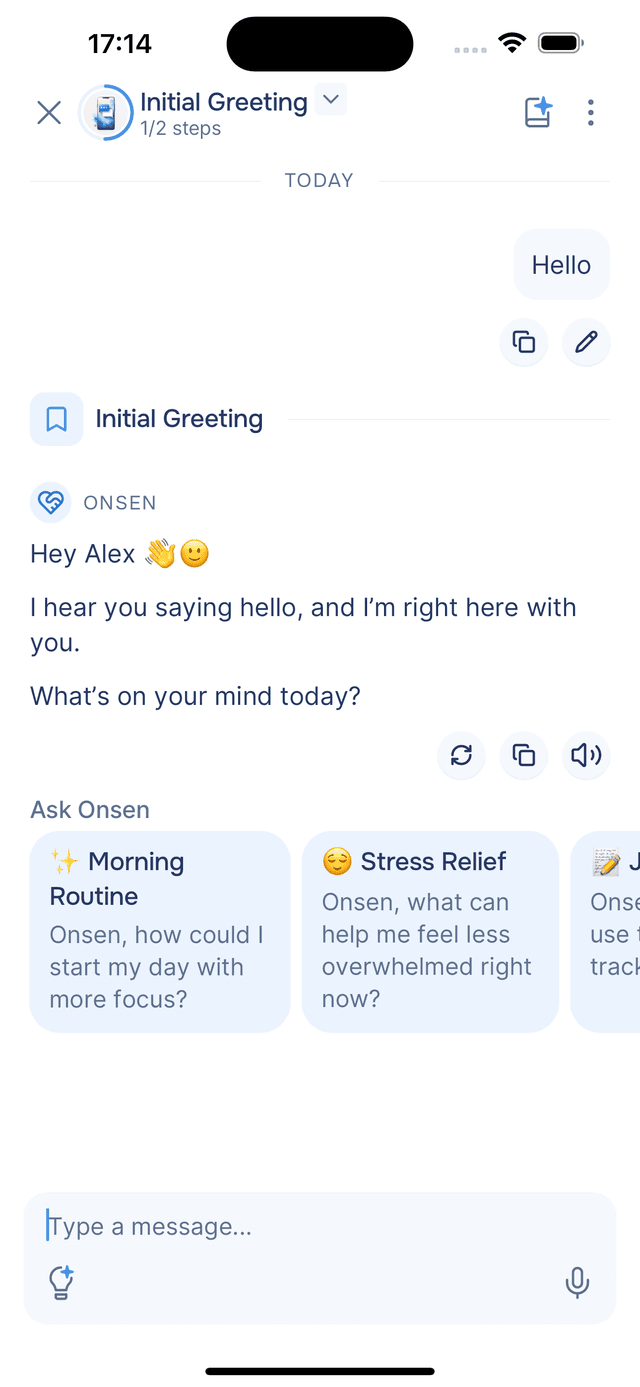
A few things Onsen is built to handle:
- The 11pm Sunday feeling. Voice chat or text, whichever feels less like effort. You don't have to explain yourself from scratch; Onsen remembers what's been going on for you.
- The "I don't want to be a burden" loop. The whole point of an AI companion is that you're not interrupting anyone's night. Read more on why talking to an AI feels easier than talking to a person. Sometimes that's exactly what you need to break the loop before it compounds.
- The wobbly week. Daily mood check-ins, a running journal, and Pulses that know your rhythm well enough to nudge at the right moment, not a random one.
Download Onsen for free. Keep it for the nights when the quiet gets loud.
Living alone doesn't mean you are alone. It means you get to decide when the quiet is good and when you need a voice in the room.
Sources
- 1.
- 2.
- 3.
- 4.Holt-Lunstad et al. (2015). “Loneliness and social isolation as risk factors for mortality.” [PubMed ]
- 5.Imamura et al. (2024). “Social isolation, regardless of living alone, is associated with mortality.” [PubMed ]
- 6.Holt-Lunstad et al. (2010). “Social relationships and mortality risk: A meta-analytic review.” [PubMed ]
- 7.Nakou et al. (2025). “Loneliness, social isolation, and living alone: Mortality risks in older adults.” [PubMed ]
- 8.Jacob et al. (2019). “Living alone and common mental disorders across three national surveys.” [PubMed ]
- 9.van Roekel et al. (2020). “Getting stuck in social isolation: Solitude inertia and depressive symptoms.” [PubMed ]
- 10.
- 11.
- 12.
- 13.Klinenberg (2012). “Going Solo: The Extraordinary Rise and Surprising Appeal of Living Alone.” [penguinrandomhouse.com ]