How to make friends as an adult
You didn't lose the skill. The scaffolding that used to do the work quietly disappeared.
There's a message sitting in your drafts. You typed it three weeks ago to someone who used to be in your life every week. You haven't sent it because it feels weird now. Weirder than it should.
The reasons change every week. Work got loud. Someone got sick. The drive is too far. The thought that lands afterward is quieter and uglier: everyone else has their people, and you don't.
You didn't forget how to make friends. The part of your life that used to make friendship happen without you trying is just gone. That's a fixable problem. Let's walk through it.
The scaffolding got quietly taken away
When you were 19, friendship was a byproduct. You lived next to people. You walked to the same buildings. You ran into the same faces six times a week without planning it. A friendship could grow in the cracks of ordinary life.
Adult life strips all of that out. A typical American moves more than 11 times in a lifetime[1]. Remote work cut the steady background of daily coworker contact. Those small shifts hit friendship harder than we realise.
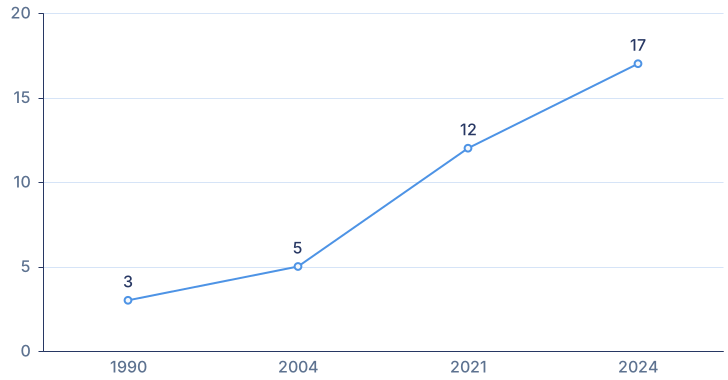
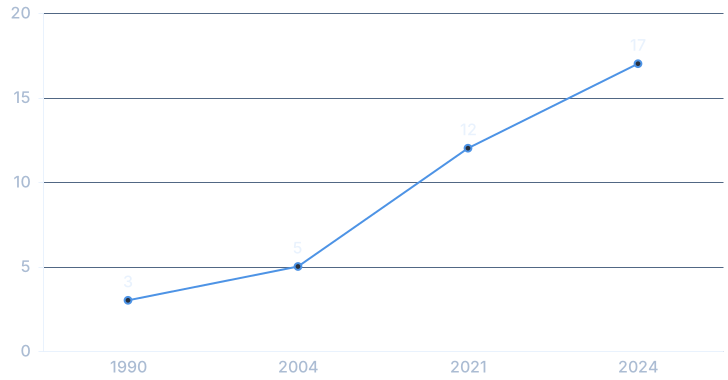
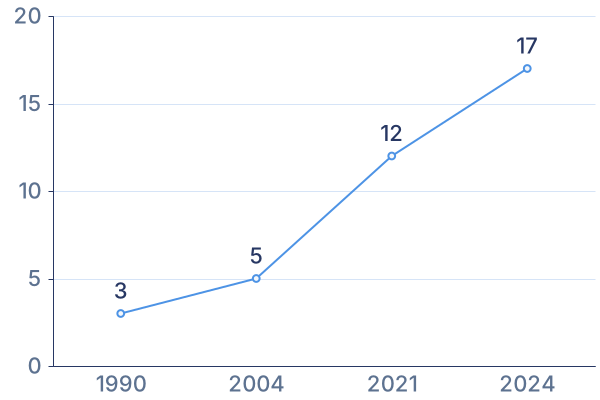
The numbers show it. In 1990, 3% of Americans said they had no close friends. Today it's 17%[2]. Among men, the shift has been especially steep: the share reporting no close friends has climbed fivefold since 1990[3]. Only about 1 in 5 Americans now have a best friend at work[4]. We cover the wider picture in our guide to the loneliness epidemic; the numbers are worse than most people think. If this lands especially hard because you're in your 20s or you live alone, our pieces on loneliness in your 20s and living alone and mental health are the companion reads.
This isn't a character flaw going around. It's a structural one. When researchers ask what makes friendship form, they consistently land on three conditions, and adult life has quietly removed all three.
The three ingredients every friendship needs
Sociologists have been saying the same thing since the 1950s. Close friendships form when three conditions overlap: proximity, repeated unplanned interaction, and a setting where you can drop the mask[5]. School and university give you all three for free. Adulthood gives you none.


Here's what that looks like across a life:
| Ingredient | What it looked like at 19 | What it looks like at 35 |
|---|---|---|
| Proximity | Same dorm, same hallway, same cafeteria | A forty-minute drive and two calendars |
| Repeated unplanned contact | Six run-ins a week without trying | Zero, unless you schedule them |
| A space to be unguarded | 2am kitchen, post-class walk, long bus ride | A work chat window and a catch-up every few months |
Once you see the three ingredients, the advice makes sense. "Just put yourself out there" fails because it doesn't supply any of them. A one-off coffee isn't proximity, isn't repeated, and thirty minutes isn't enough time to let the guard down. You can be trying for a year and still not make a friend if none of the three ingredients are in place.
The work, then, isn't to force yourself to be more social. It's to rebuild small pockets of proximity and repetition that do some of the work for you.
The awkward math of how long it actually takes
Here's the part nobody tells you. Friendship takes a specific number of hours, and that number is higher than you'd guess.
Jeffrey Hall, a communication researcher at the University of Kansas, tracked how friendships deepen over time. His data suggests it takes roughly 50 hours together to move from acquaintance to casual friend, around 90 hours to feel like a real friend, and 200-plus hours to become close[6]. Leisure hours count more than work hours. A meeting together doesn't move the needle. Getting dinner does.
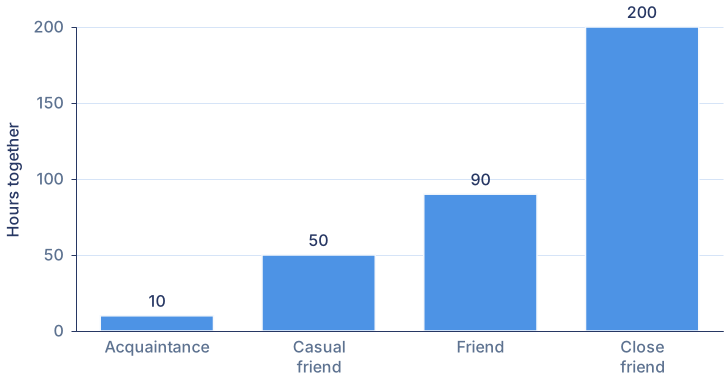
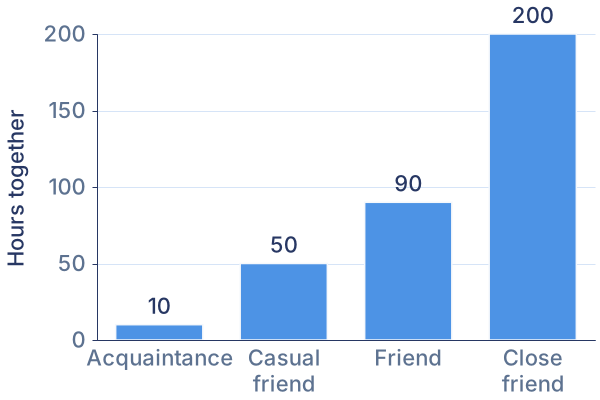
This reframes a lot. The new colleague who feels like "kind of a friend" after three lunches is exactly on track. The dinner group you've been rotating with for a year that still feels "not quite close" is on track too. You're not failing. You're in hour 70 of a 200-hour process.
When you know that, the pressure drops. A single hangout isn't supposed to create a close friend. It's supposed to contribute three hours. If the next one happens, that's six. Repetition does the work, not chemistry.
One more number worth holding. Researchers at MIT who tracked real friendships against people's self-reported ones found that only about half of the people we call friends would call us the same back[7]. That sounds sad. Read it again. It means the anxious voice whispering "they probably don't think of me as a friend the way I do of them" is, statistically, a coin flip, not a verdict. It's also evidence that most people are walking around slightly uncertain about where they stand with us, too. They're just as likely to be waiting for you to text as you are for them.
What to actually do this week
This is where most friendship articles go soft, so we're going to be specific. Everything below is organised around the three ingredients.
| Ingredient | Core move | Do this week |
|---|---|---|
| Proximity | Design it in small doses. Pick one recurring thing and default to it. | Pick one weekly slot — a climbing gym Wednesday, a Sunday market, a co-working café — and put it on the calendar. |
| Repeated unplanned contact | Offer a low-stakes recurring thing, not a one-off "we should catch up." | Text one person: "Want to make Wednesdays a walk?" |
| Unguarded space | Give small, honest answers when polite ones would do. | Swap one "yeah, fine, you?" for "it's been a weirdly heavy week, actually." |
Build proximity on purpose
Proximity used to be free. Now you have to design it in small doses.
- Pick one recurring thing. A climbing gym on Wednesdays. A Sunday farmers' market. A parents' pickup you actually show up to. A co-working café once a week. Not "go sometimes". One fixed slot you default to.
- Give it at least six weeks before you judge. Hall's data is clear on the shape of this: the acquaintances who stay acquaintances are the ones who never accumulated enough hours. People who become friends simply showed up more.
- Talk to people you already run into three times. If you've seen the same face three weeks running, you have permission to say "hey, I keep running into you. I'm [name]." That is the whole script.
Engineer repeated unplanned contact
If you can't run into someone naturally, create a weak version of the scaffolding.
- Offer a low-stakes recurring thing. "Want to make Wednesdays a walk?" beats "we should catch up sometime" by a mile. Sometime never happens. Wednesdays do.
- Group beats dyad early. Three or four people is easier than a one-on-one at the acquaintance stage. Nobody has to carry the whole conversation. The natural follow-on is "same time next month?"
- Use the two-hour rule for old friends. A dormant friendship that mattered can often be rekindled by two hours of catch-up with zero agenda. Long enough to move past "how's work," short enough that nobody cancels. Put it on a calendar. Repeat quarterly.
Make space for the guard to come down
Proximity and repetition get you to acquaintance. Small, mutual vulnerability is what moves a casual friend to a real one.
Research on self-disclosure[8] lands on something simple and useful: people like the people who let them in. Sharing something real (not harrowing, just real) makes the other person like you more, not less. The voice that says "they don't want to hear it" is usually wrong.
This doesn't mean trauma-dumping. It means giving small, honest answers when you could have given polite ones. "It's been a weirdly heavy week, actually" instead of "yeah, fine, you?" The person across from you almost certainly has their own heavy week and has been waiting for someone to go first.
If that's hard because there's a voice saying you're too much, you're bothering them, they already have enough going on, that voice isn't truth. It's a habit. It's worth naming.
The voice that makes it harder
There's a specific head-noise that shows up right as you try to reach out. It sounds like:
- They haven't texted me, so they probably don't want to hear from me.
- I waited too long, it's weird now.
- I'm going to seem desperate.
- What do I even have to say.
That voice has a few features worth knowing. It's loudest right before you do the thing that would help. It narrates other people's minds with total confidence and zero data. It confuses "I feel awkward" with "this is actually a bad idea."
| What the voice says | What's actually true |
|---|---|
| They haven't texted me, so they don't want to hear from me. | People are as likely to be waiting on you as you are on them. The MIT data says it's a coin flip. |
| I waited too long, it's weird now. | "No reason, no ask, miss you" fixes a four-year gap in one sentence. |
| I'm going to seem desperate. | Desperate is begging. Showing up consistently is the opposite of it. |
| What do I even have to say. | You don't need something to say. You need to show up. Something to say is what happens next. |
Loneliness itself tilts the brain this way. Research on the cognitive effects of loneliness[9] finds that lonely people scan for social threat more, remember more negative social information, and expect rejection in interactions that weren't actually rejecting. The loop is self-protective and self-defeating at the same time. It makes reaching out feel dangerous in a situation where it almost never is.
The useful move is to stop debating the voice and start naming it. "The I'm-too-much voice is loud right now." "The they-haven't-texted-first voice is back." Naming a feeling takes some of the steam out of it and puts the deciding part of your brain back in the driver's seat. If it's showing up hard, our guide to challenging negative self-talk has the full playbook. If the loudness comes from a friendship that drains more than it gives, our piece on how to deal with toxic friendships is a better starting point.
Then do the thing the voice is trying to stop. Send the text. Keep the walk. Say the slightly real answer.
How Onsen can help
The hardest part of adult friendship isn't the logistics. It's the head-noise around the logistics: the rehearsing, the re-reading, the "is this weird," the story you're telling yourself about why they haven't replied.
That's the part Onsen is actually useful for. Not "have AI be your friend." More like a private space to untangle what's going on in your head before you act on it. A guide who'll help you draft the text, check whether the "they hate me now" story is true, and keep you honest about the pattern you're in.
A few moments that help:
- Before the reach-out. Type the name of the person into Onsen and describe what you want to say. The guide will help you cut the over-explaining, drop the pre-apology, and find the version that sounds like you.
- After a hangout that didn't land how you hoped. A five-minute guided reflection turns the post-coffee spiral ("did I talk too much, were they bored, why did I bring up that thing") into something you can actually learn from.
- The quiet between-times. Pulses check in while you're building a new habit of contact, so a week doesn't go by without you noticing that it's been three of them since you saw anyone you like.
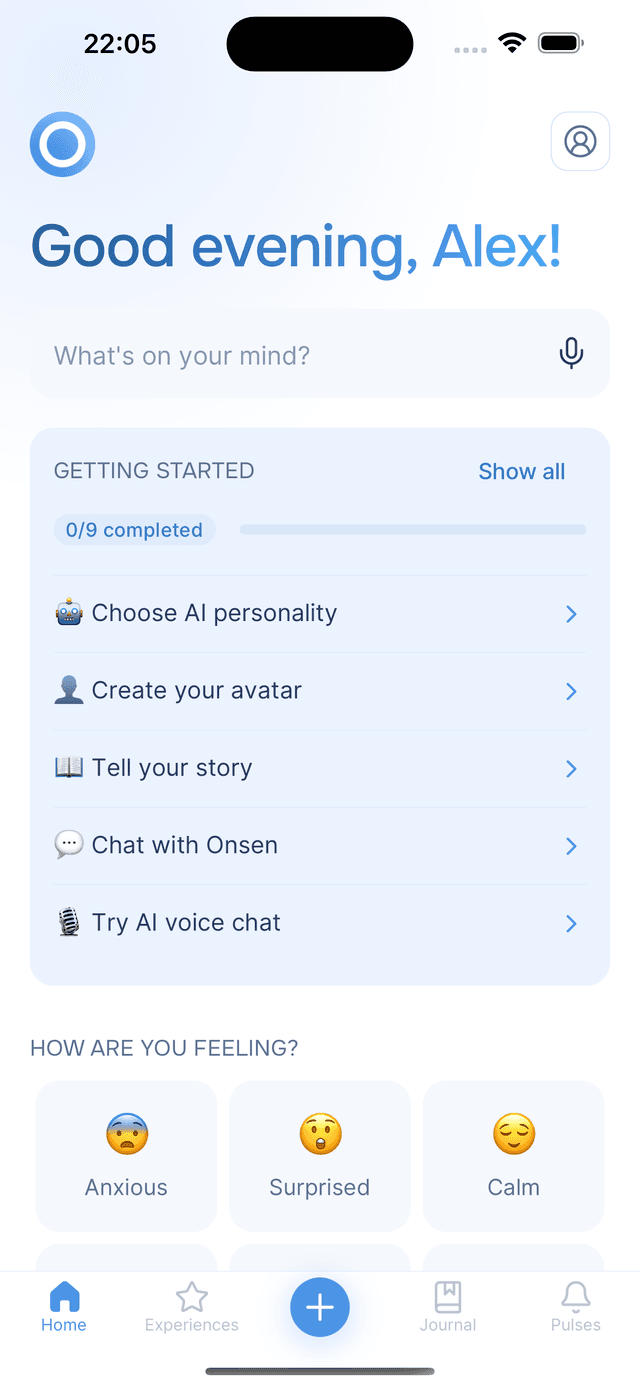
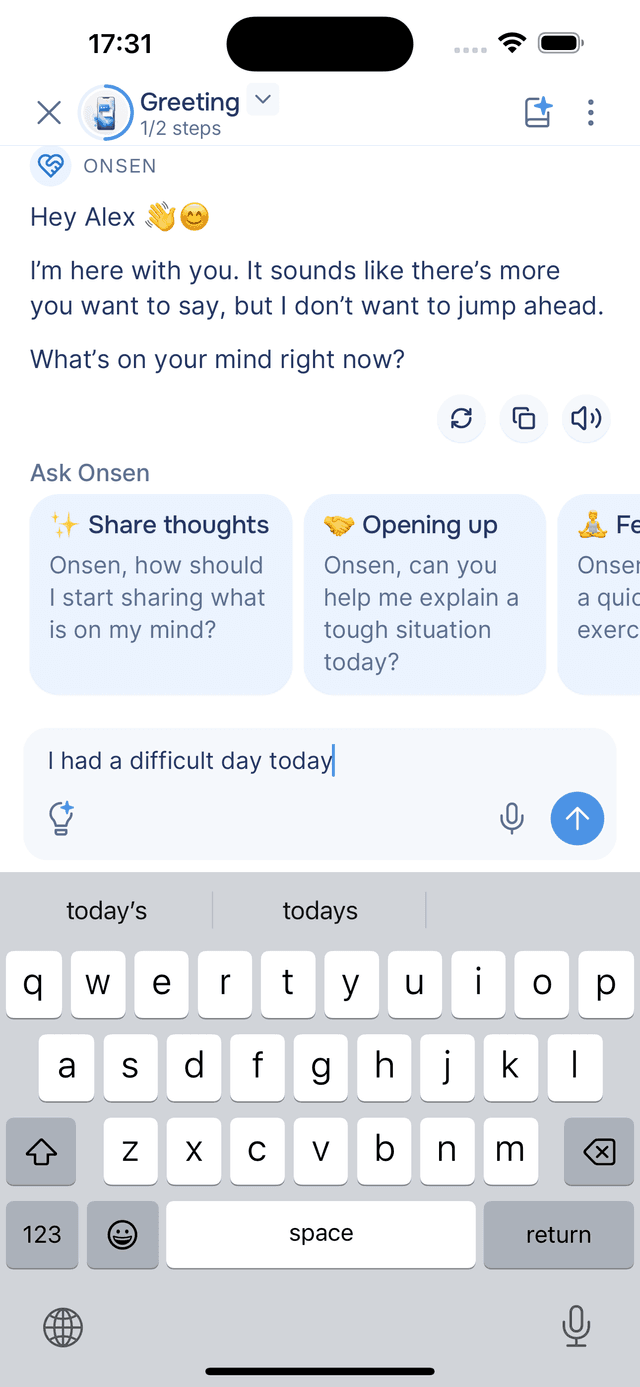
Onsen is free to download. Use it as a rehearsal room, not a replacement. The goal is to get you to the people who matter, with less of the head-noise in the way.
The last thing
There isn't a version of your life where friendship stops requiring time. The forty-minute drive, the calendars, the weeks that slip: none of that is going away.
What can change is the story you tell about what's happening. You're not too far gone. You're a few dozen hours into something that was always going to take a few hundred, with a drafts folder full of messages nobody is mad about. Send one. Walk the same loop on Wednesdays. Answer one "how are you" slightly more honestly than you were going to.
Friendship doesn't come back all at once. It comes back the way it always did, in small, boring, repeated moments that add up.
You haven't lost the people. You've just lost the scaffolding. You can build a smaller, stronger version yourself, one Wednesday at a time.
Sources
- 1.
- 2.
- 3.Cox (2021). “The State of American Friendship: Change, Challenges, and Loss.” [americansurveycenter.org ]
- 4.
- 5.Williams (2012). “Friends of a Certain Age (New York Times, quoting sociologist Rebecca G. Adams).” [nytimes.com ]
- 6.
- 7.
- 8.
- 9.