Loneliness in your 20s: why it hits so hard
The decade that looks full from the outside, empty from the inside.
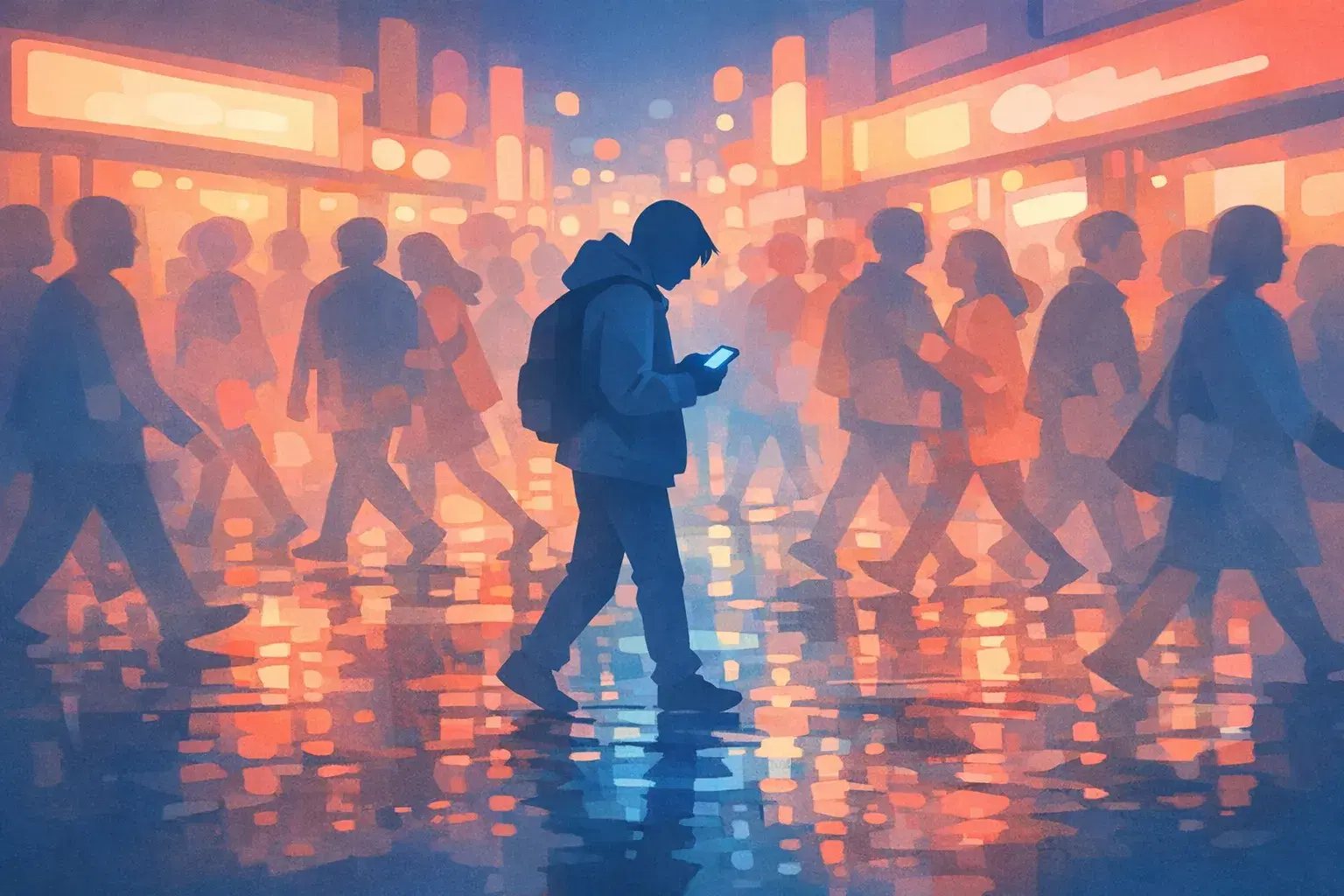
It's 9pm on a Saturday. You cooked for one. The story at the top of Instagram is four of your friends from college at a rooftop bar you weren't invited to, and your first thought isn't hurt, it's tired. When did everyone get so busy. When did it get this hard to just see people.
You open the texts you've been meaning to send. Three drafts. None go out.
If that scene lands, you are not broken and you are not alone. Your 20s are, statistically, the loneliest decade of adult life. The surprise isn't that you feel this. The surprise is how thoroughly everyone pretends they don't.
Your 20s are the loneliest decade, not old age
The image of loneliness is an old person in an armchair. The data says otherwise.
When researchers ran the BBC Loneliness Experiment on 46,054 people across 237 countries and territories, loneliness didn't climb with age. It started at the top. People aged 16 to 24 reported the highest loneliness of any age group, and it dropped steadily through midlife before rising again in very old age[1]. A large nationally representative German study found the same two-humped shape: loneliness is highest among the young and the oldest-old, not in between[2].
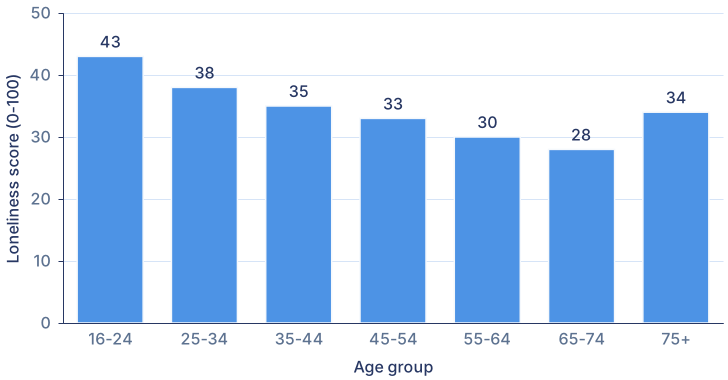
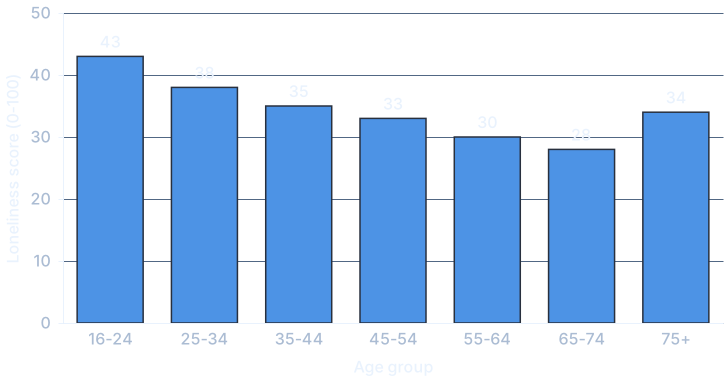
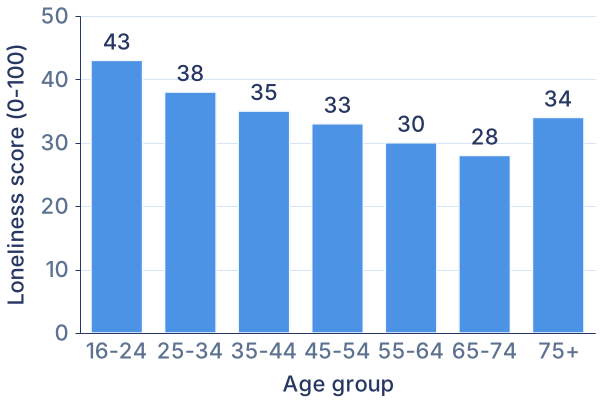
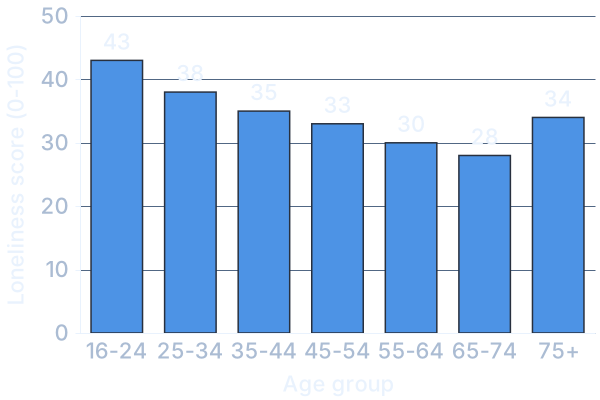
US surveys show the same pattern. In a pre-pandemic Cigna report of 10,441 Americans, 79% of 18 to 22 year-olds said they felt lonely[3]. That's the highest of any generation, and well above the 50% reported by Boomers. So the thing you are feeling on a Tuesday night is not an early warning that something is uniquely wrong with your life. It's the modal experience of your age.
That is a weird kind of comfort. It also raises a harder question: why.
What changed between then and now
The honest answer is that connection in your 20s isn't like connection in college or school, and nobody really warned you. Three specific things fall out from under you.
Structured proximity disappears. Before, the people you saw every day were handed to you by geography. Classes, dorms, buses, the same hallway. You didn't have to schedule a friend; you just sat next to them for ten weeks. After graduation, every friendship has to be actively scheduled by both people on non-overlapping calendars in different cities.
Workplace friendships don't do the same work. You do spend most waking hours at work, but work friendships run into real tensions. The informal, voluntary, supportive core of friendship rubs against formal roles, performance reviews, and the awareness that your "friend" is also someone you're implicitly competing with[4]. Most coworkers stay in a useful middle zone: warm, not close. And the data is blunt. Young Americans' social time with friends has been falling for two decades, and long work hours are one of the strongest structural reasons why[5].
Your life is reshuffling faster than your friendships can keep up. You move cities. A partner appears, and research suggests people in new romantic relationships form fewer new friendships over time[6]. Someone has a baby. Someone gets an MBA. Even leaving the parental home before 18 predicts more loneliness in the years after, not less[7]. Every transition is a quiet test your friendships have to survive, and most friendships are not built for that many tests in a row.
| What connected you then | What connection requires in your 20s |
|---|---|
| Daily proximity (school, dorm, campus) | Scheduled meetups across calendars and cities |
| Shared routines you didn't pick | Routines you have to invent and defend |
| One big, stable identity (student) | Identity you're still figuring out |
| Friends all in the same life stage | Friends in wildly different life stages |
| Free time most evenings | Whatever hours work and commuting leave |
The adult friendship researcher Jeffrey Hall has put a rough clock on this. His data suggests it takes roughly 50 hours of time together to move from acquaintance to casual friend, 90 hours to become a real friend, and more than 200 hours to become close[8]. In college you could rack up 200 hours with someone in a month. In your 20s, 200 hours with one specific person can take a year, assuming nobody cancels.
The 20s loneliness loop
Loneliness in your 20s is rarely a clean "I have no friends." More often it's a feedback loop that tightens quietly.


The loop is well-documented. A three-wave study found that loneliness at one timepoint predicted higher social anxiety, paranoia, and depression months later[9]. The only symptom that predicted future loneliness in the other direction was social anxiety. Earlier loneliness also predicts depression down the line, even after controlling for social support and life stress[10].
So the scariest part of 20s loneliness isn't Saturday night. It's that the longer the loop runs, the more reasonable "staying in" starts to feel, and the more the reaching-out muscle atrophies. The head noise ("I'm behind, I'm too much, they're just being polite") is part of the machinery. It isn't a reliable signal.
If that head noise sounds familiar, our guide to challenging negative self-talk has the specific tools to pick it apart.
Why it hits so hard, specifically
The raw loneliness isn't the whole story. Three other things pile on top of it.
| What piles on | The lie it tells you |
|---|---|
| The "best years" script | If I'm lonely right now, I'm failing at my 20s. |
| Your phone as comparison machine | Everyone else has already figured out their social life. |
| Identity in motion | Real friendships should be easier by now. |
You're supposed to be having the time of your life. When the Saturday is a microwave dinner and three unsent texts, the loneliness gets a second layer: shame for being lonely when you "should" be having fun.
Your phone is a comparison machine. Scrolling passively through other people's highlight reels, without posting or messaging back, has been shown in controlled experiments to pull mood down over time, through a very specific mechanism: envy[11]. Researchers named "fear of missing out" to describe the apprehension that others are having rewarding experiences you're absent from[12].
Identity is a moving target. Psychologist Erik Erikson called this life stage "intimacy versus isolation," and argued that the work of your 20s is to figure out who you are solidly enough to let someone else actually see it. A long-running study following people from their 20s into their 60s found those who reached a clearer identity earlier had more satisfying intimacy and connection in the decades that followed[13]. When you don't know what you want, what you believe, or where you'll live in two years, it is genuinely harder to build the deep friendship that survives a decade. That's not a character flaw. That's the stage.
Qualitative interviews with young adults found they tended to describe loneliness as "a part of growing up," an expected feature of life in motion rather than a sign something has gone wrong[14]. That framing is accurate. It is also, bluntly, still hard to sit inside.
What actually helps, starting tonight
The research on what reduces loneliness is more practical than you'd think. Three moves you can make this week.
| Move | One copyable action tonight |
|---|---|
| Kill passive scrolling, not your phone | Set an app timer to 30 minutes on your worst feed, or delete the app and only open it in a browser. |
| Trade an hour of alone time for an hour with a human | Pick one specific person. Send one specific invitation: "running Wednesday 7pm, you in?" — not "we should hang out." |
| Join something that meets on a schedule you don't control | Book one slot you default to: a running club, pickup team, choir, board-game night, weekly class. Pick for the schedule, not the activity. |
1. Kill passive scrolling, not your phone. In a randomized study at the University of Pennsylvania, students who limited Instagram, Facebook, and Snapchat to a combined 30 minutes per day for three weeks showed significant drops in loneliness and depression compared to controls[15]. The active parts of social media (messaging a specific person, replying to a specific story) weren't the problem. The passive scroll was.
2. Trade one hour of alone time for one hour with a human. Friendship research keeps hitting the same finding: consistency of time together matters more than intensity. Hours accumulate. A weekly hour, repeated for a year, is closer to how deep friendship actually gets made than an occasional big hangout.
3. Join something that meets on a schedule you don't control. Group-based interventions are the most consistently effective category in the loneliness literature, because a standing group reintroduces the structured proximity your 20s took away[16]. A running club, a pickup team, a choir, a board game night, a class that meets weekly. You don't have to love the activity. You need something where the same people show up every Thursday without you having to be the organizer.
If the head noise sounds like social anxiety rather than just missing people, our guide on cognitive distortions and how to spot them walks through the patterns. If the isolation is showing up because of where you live more than who you know, living alone and mental health is worth a read. For the practical playbook on rebuilding your bench, how to make friends as an adult is the companion piece. And the broader loneliness epidemic piece puts the generational picture in full context.
How Onsen can help
The honest limit of any article on loneliness: reading about it is not the same as having someone to actually talk to when it's too late to text anyone and the loop is loudest. Most people in their 20s know what they "should" do, and still find themselves staring at an unsent text.
Onsen is the part that sits in that gap. It isn't a replacement for the friends you are slowly rebuilding, the group you'll eventually join, or (if you need it) a therapist. It's a warm, private place to put the head noise into words in real time, so that tomorrow's attempt to reach out has less weight behind it.

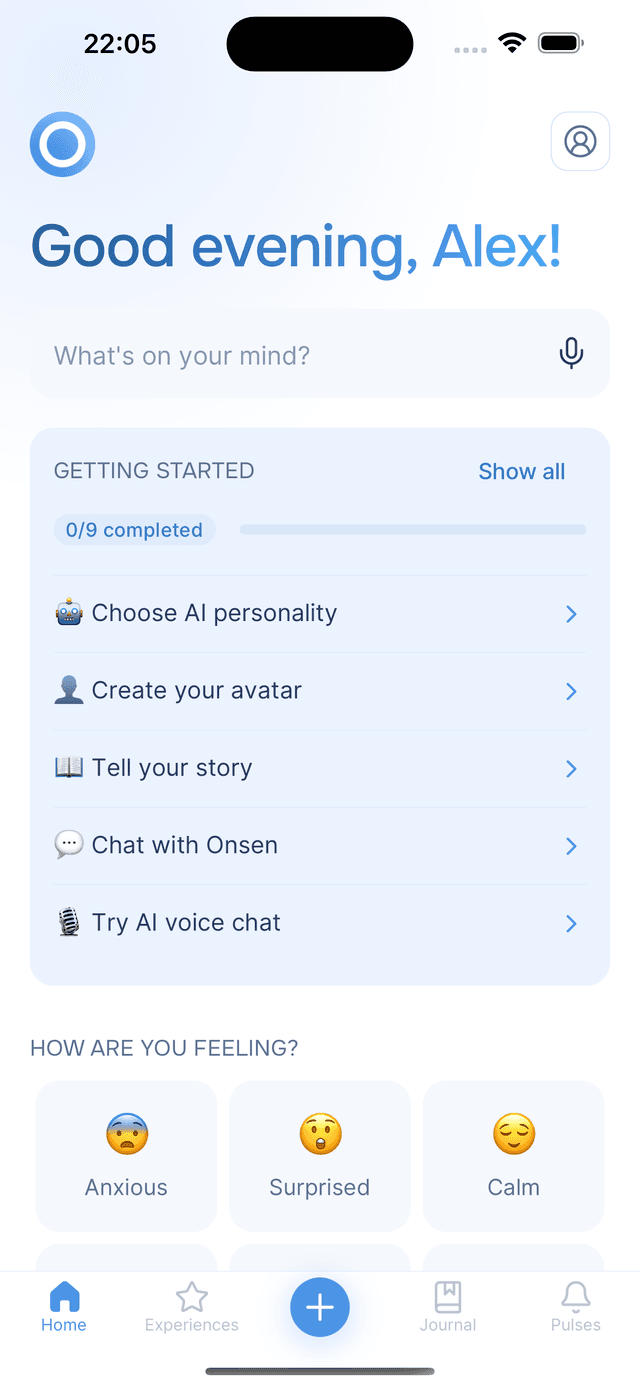
A few specific things that help:
- Chat with a personality that fits you. Four built-in guides (warm, direct, playful, grounded) so the voice you're talking to feels human, not generic.
- Guided reflections for the heavier nights. Short, structured experiences for rumination, social comparison, and "why do I feel behind," built on cognitive behavioral therapy. A recent review of AI conversational agents across fifteen randomized trials found meaningful drops in depression and distress symptoms[17]. In a separate survey of over a thousand student users of a generative-AI chatbot, users reported feeling more supported than the typical student baseline, and 3% said the chatbot had halted their suicidal ideation[18].
- Mood tracking that surfaces patterns, so the "nothing bad happened today, I just feel off" weeks stop looking random.
Download Onsen for free if you want something in your pocket for the late-night version of you, before the loop has to win again.
Your 20s are not supposed to feel full. They are supposed to feel in motion. Lonely is a normal weather pattern in a life that is still becoming itself. Send the draft.
Sources
- 1.Barreto et al. (2021). “Loneliness around the world: age, gender, and cultural differences in loneliness.” [PubMed ]
- 2.Luhmann & Hawkley (2016). “Age differences in loneliness from late adolescence to oldest old age.” [PubMed ]
- 3.
- 4.Pillemer & Rothbard (2018). “Friends without benefits: understanding the dark sides of workplace friendship.” [DOI ]
- 5.Kannan & Veazie (2023). “US trends in social isolation, social engagement, and companionship.” [PMC ]
- 6.Zhang & Felmlee (2024). “Romance matters: the role of dating in friendship beginnings and endings.” [DOI ]
- 7.von Soest, Luhmann & Gerstorf (2020). “The development of loneliness through adolescence and young adulthood.” [PubMed ]
- 8.
- 9.
- 10.
- 11.
- 12.Przybylski et al. (2013). “Motivational, emotional, and behavioral correlates of fear of missing out.” [DOI ]
- 13.Mitchell et al. (2021). “The continued importance of Erikson's stages of psychosocial development.” [PMC ]
- 14.
- 15.Hunt et al. (2018). “No more FOMO: limiting social media decreases loneliness and depression.” [DOI ]
- 16.Hansen et al. (2025). “Interventions to reduce loneliness: a systematic review and meta-analysis.” [PubMed ]
- 17.Li et al. (2023). “Systematic review and meta-analysis of AI-based conversational agents for mental health.” [DOI ]
- 18.Maples et al. (2024). “Loneliness and suicide mitigation for students using GPT3-enabled chatbots.” [PubMed ]