Communication in relationships: what therapists actually recommend
The problem is rarely the words. It's what you do with the micro-moments between them.

It's Sunday night, dishes still in the sink, and you've just had the same argument for the fourth time this month. You know the script. One of you raised your voice. The other went quiet. You slept on opposite edges of the bed, and in the morning neither of you brought it up because what was the point.
You love them. You know you do. You just don't know how to talk to them anymore.
Most fights aren't about what you think they're about
If you asked each of you what the fight was about, you'd probably give different answers. "The dishes." "Her tone." "His phone." "The thing about my mom."
The topic changes. The pattern doesn't.
After 40 years of studying couples in a lab, the psychologist John Gottman found that about two-thirds of the conflict in most relationships is about problems that never fully get solved[1]. Different sleep schedules. One of you wants more time with family, the other wants less. One of you processes money like a planner, the other like a vibe. These aren't bugs to fix. They're the terrain you live on.
What decides whether a relationship thrives isn't whether these problems exist. It's what happens in the loop you fall into when they come up.


Researchers call this demand-withdraw[2]: one partner pushes harder, the other pulls back further. You might just call it the thing we always do. It tends to run in a gendered direction (the one asking for change is more often the woman; the one who shuts down is more often the man), but it isn't a rule. The loop itself is human. It's not a sign your relationship is broken. It's a sign your nervous systems are under stress at the same time.
The loop lands harder when one of you isn't fully present. A 2025 study that tracked phones objectively[3] found that people spent about 27% of their time around their partner on their phone. What predicted lower relationship satisfaction wasn't overall phone use — it was specifically how much phone use happened during time together. Half-listening while you scroll is its own version of turning away.
The four moves that quietly take a relationship apart
Gottman identified four communication moves that, in his lab, predicted divorce better than anything else[4]. He called them the Four Horsemen. The names sound dramatic. The moves are mundane enough that most couples do them without noticing.
| Horseman | What it sounds like | Antidote |
|---|---|---|
| Criticism (attacking character, not behavior) | "You never think about anyone but yourself." | Soft start-up. Say what you feel and what you need: "I felt lonely tonight. Can we plan something just us this week?" |
| Contempt (eye-rolls, sarcasm, name-calling; the sense that you're above your partner) | "Oh, great idea." [sigh] | Build appreciation. Small, specific thank-yous, repeated. Contempt is starved by noticing out loud what your partner does well. |
| Defensiveness (counter-attacking instead of hearing) | "Well, you didn't do the laundry either." | Take one piece of responsibility, even a small one. "You're right, I was short with you. I was stressed and I took it out on you." |
| Stonewalling (shutting down, going silent, leaving) | [staring at phone, nothing said] | Take a real break. Say: "I'm flooded. I need 20 minutes and I'll come back." Then come back. |
Contempt is the one that matters most. Across Gottman's work, it's the strongest predictor of a relationship ending. It's the one to watch for in yourself, not just your partner.
If you notice the contempt horseman mostly shows up in your head (the eye-roll you didn't do, the sarcastic comment you bit back), that's worth paying attention to. Our guide to challenging negative self-talk has tools for catching the story you're running about your partner before it becomes the way you talk to them.
The tiny moments that decide everything
The dramatic fights aren't actually what matters. What matters is a thousand small moments that don't look like communication at all.
Gottman calls them bids for connection[5]. A bid is any little attempt to get your partner's attention, affection, or support. "Look at this bird." "Ugh, long day." "Do you want to watch the show?" They're so small they barely register. You can turn toward them (look up, respond, engage) or turn away (ignore, half-listen, stay in your phone).
In a six-year follow-up of 130 newlywed couples from Gottman's apartment-lab study, couples who stayed together turned toward each other's bids about 86% of the time[6]. Couples who divorced had done it 33% of the time.
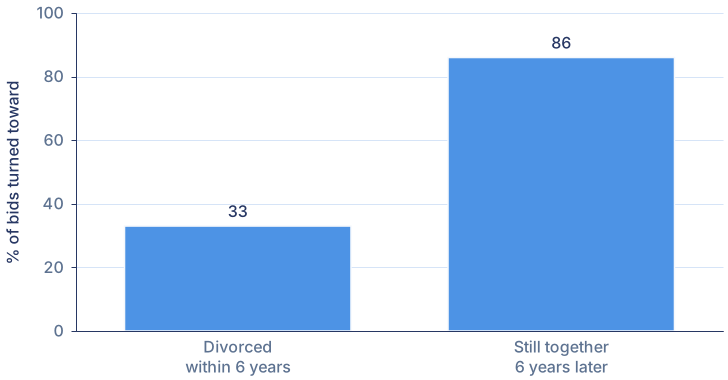
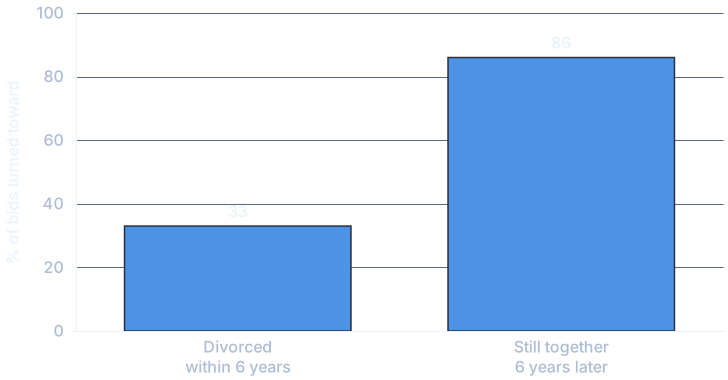
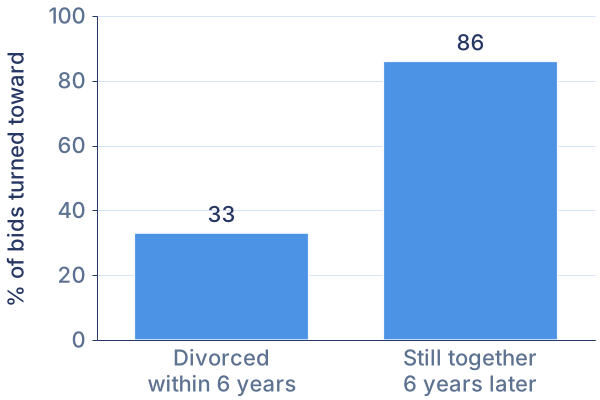
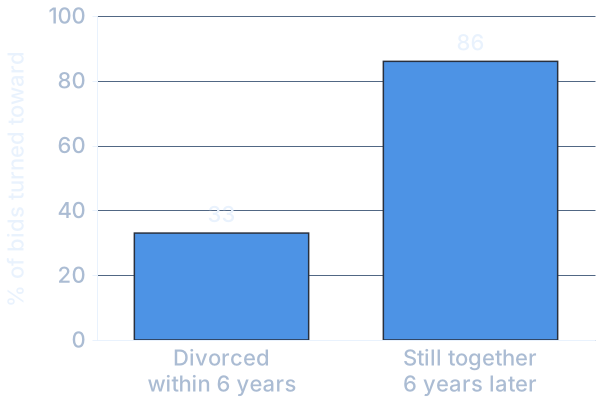
This finding is reported in Gottman Institute materials rather than in a standalone peer-reviewed paper, so treat the specific numbers as illustrative. The direction holds, though. Small daily attention compounds. So does small daily inattention.
Here's a quick self-test you can run tonight:
What to actually say
"Communicate better" is useless advice. What works are specific scripts you can borrow and rewrite in your own voice. Here are the four therapists teach most often, with when to use each.
| Situation | The script | The move underneath |
|---|---|---|
| Starting a hard conversation | "I feel [feeling] when [specific behavior] because [the need underneath]. Would you be willing to [specific, doable request]?" | Soft start-up — replaces blame with a felt need. |
| Feeling flooded mid-fight | "I can feel myself getting flooded. I need 20 minutes. I'll come back at [time] and we'll pick this up." | A real break, stated out loud, with a return time. |
| After you've been in the wrong | "I was wrong. I did that. I'm sorry." | Acknowledge responsibility first. Everything else is secondary. |
| When you go quiet and don't know what to say | "I don't know what to say right now. Give me until tomorrow morning and I'll come back to this with you." | Name the shutdown, promise the return, then actually return. |
Soft start-up: the first 90 seconds of a hard conversation
Gottman's lab data on the first three minutes of a conflict discussion is consistent: the way a difficult conversation starts is one of the strongest predictors of how it ends. A harsh start-up (criticism, blame, contempt) rarely recovers. A soft one usually does.
The template comes from Marshall Rosenberg's Nonviolent Communication[7]:
I feel [feeling] when [specific behavior] because [the need underneath]. Would you be willing to [specific, doable request]?
Example: "I feel lonely when we both end up on our phones after dinner because I really miss just talking to you. Would you be willing to keep phones in the other room for 20 minutes tomorrow night?"
NVC language can sound robotic the first few times you use it. That's a real critique of the method[8], and the fix is simple: don't perform the formula. Borrow the skeleton, use your own words.
The 20-minute break (said out loud, not enacted silently)
When either of you is flooded (heart rate up, chest tight, vision narrowing) your body has moved into fight-or-flight, and almost nothing productive can happen in the next few minutes. Men tend to flood faster in conflict, which is part of why stonewalling shows up more often in one direction.
The fix isn't willpower. It's a break, stated out loud, with a return time.
The apology that actually lands
Most of the apologies you've given probably weren't really apologies. They were explanations, deflections, or "I'm sorry you feel that way" (which is not an apology; it's a feedback note on your partner's feelings). Research on what makes an apology actually land, across 755 adults[9], keeps pointing at one ingredient above the others: acknowledgement of responsibility. "I was wrong. I did that." Skip that and the rest doesn't matter. The least-necessary ingredient, interestingly, was asking for forgiveness. You can leave that one out.
If you find yourself stuck in defensive loops instead of apologizing, how to reframe negative thoughts has the thought-record pattern that can interrupt "but I didn't mean it that way" before it becomes the whole fight.
For the partner who goes quiet
Stonewalling isn't always stubbornness. Often it's a nervous system that learned, young, that staying small was safer than being seen. If you're the one who shuts down, you're not failing. You're protecting. What your partner needs from you isn't the perfect answer in the moment. It's the return.
One line that works: "I don't know what to say right now. Give me until tomorrow morning and I'll come back to this with you." Then come back. For men in particular, this shutdown pattern has a longer backstory worth understanding. Our piece on why men don't talk about mental health covers the social conditioning under it.
The text-tone problem
One quick modern note: you are much worse at being understood over text than you think you are. In a study of email tone[10], senders predicted about 78% accuracy for conveying sarcasm or sincerity. Actual accuracy was around 56%, close to a coin flip. The rule: hard conversations don't happen in text. If a thread is starting to escalate, the fix isn't a better text. It's "can I call you in five minutes?"
How Onsen can help
Most of the work of communication happens inside your head, before you open your mouth. The story you're running about what your partner meant. The rehearsed response. The version of the conversation you had in the shower that they'll never get to hear.
That's the part that's hardest to practice with an actual human, and it's exactly where Onsen tends to earn its keep in relationship moments. A few ways it fits:
- Rehearse the hard conversation before you have it. Open a chat, set the scene ("I want to tell my partner I've been feeling lonely without it turning into a fight"), and talk through the soft start-up a few times until it sounds like you, not a workshop.
- Run a thought record when the story in your head is running you. "He didn't text back because he doesn't care" becomes easier to interrupt when you put it on paper and look at the evidence. Our thought record guide walks the pattern if you're new to it.
- Do a quick post-fight check-in with yourself before you try to do one with your partner. Pulses and mood check-ins let you ask: what was I actually feeling under the anger?
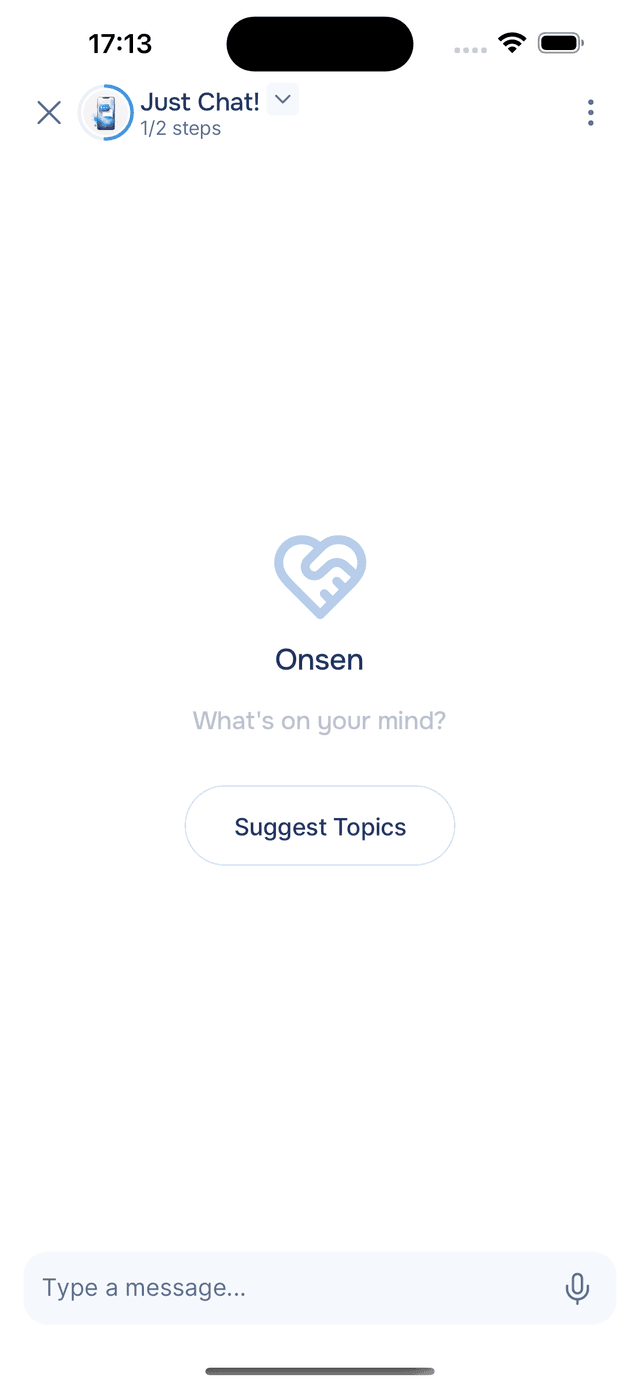
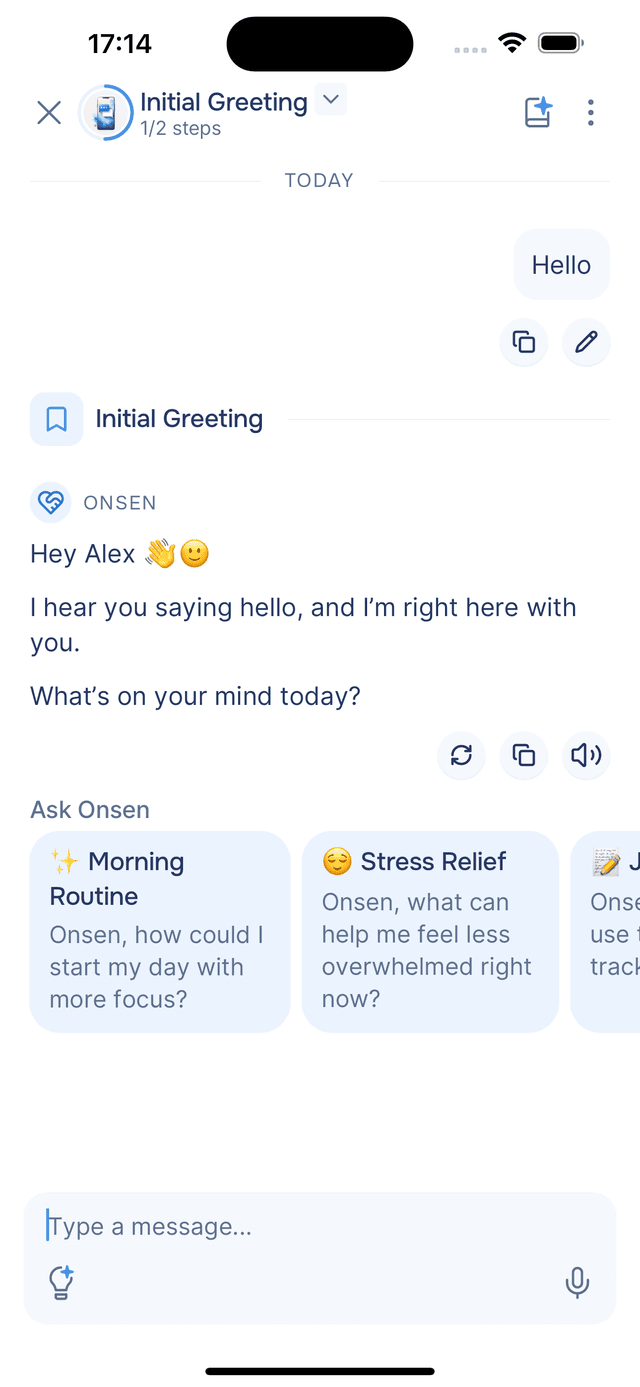
None of this replaces a couples therapist if you're stuck in a cycle you can't break on your own. EFT (emotionally focused therapy) has strong evidence for distressed couples[11]. If the loop has gotten bad enough that you can't interrupt it, that's a signal, not a failure. Download Onsen for free for the between-sessions work. For the cycle itself, a good therapist is worth every hour.
If distance is part of your story, our piece on long-distance relationships and mental health covers the ways proximity changes, and doesn't change, the communication pattern.
One thing to take away
Back to the 11pm Tuesday. You probably can't stop having the argument. You can change how you start it, how you come back to it, and what you do with the thousand small moments that fill the days around it.
Notice one bid today. Turn toward it.
Sources
- 1.
- 2.Christensen & Heavey (1990). “Gender and social structure in the demand/withdraw pattern of marital conflict.” [PubMed ]
- 3.
- 4.
- 5.Driver & Gottman (2004). “Daily marital interactions and positive affect during marital conflict among newlywed couples.” [PubMed ]
- 6.
- 7.
- 8.
- 9.Lewicki, Polin & Lount (2016). “An Exploration of the Structure of Effective Apologies.” [onlinelibrary.wiley.com ]
- 10.Kruger, Epley, Parker & Ng (2005). “Egocentrism over e-mail: Can we communicate as well as we think?.” [PubMed ]
- 11.Spengler, Lee, Wiebe & Wittenborn (2022). “A comprehensive meta-analysis on the efficacy of emotionally focused couple therapy.” [DOI ]